Four prompts. One AI. Ten publishable data stories.
A UN dataset too big for any single journalist to read in full.
An AI that read it, found the surprises, rendered them in brand format,
and wrote the verification guides — while the human wrote four short sentences.
4human prompts
0lines of code written by AI
10print-ready data cards
🎙️
Listen: The Plumbing Behind the Prose
A 3-minute audio walkthrough of how AI built this entire pipeline — from raw UN data to publication-ready cards. Same story you're about to read, in spoken form.
The Setup
A dataset too big to read. A deadline too short to wait.
The UN's
SDG dataflow is one of the most comprehensive datasets ever assembled. It tracks 195 countries across
indicators spanning remittances, refugee flows, biodiversity, parliamentary representation, water law,
and a hundred things in between.
UN SDG Global Dataflow: 15 streams, 195 countries, millions of data points per year.
It is also, in its raw form, almost completely unreadable by a human on a deadline. The data is encoded
in SDMX: Statistical Data and Metadata eXchange. Dense XML format used by statistical agencies worldwide.SDMX format,
spread across dozens of indicator codes, and arrives as compressed CSV slices you have to know how to ask for.
Someone at a news organisation would normally need a data journalist, an API expert, two weeks, and
a research budget. Instead, here is what actually happened: one editor typed four short prompts
into an AI coding assistant. What came back changed what a newsroom data workflow can look like.
"The human wrote roughly 200 words total. The AI wrote 1,929 lines of production code, ran the analysis
three times, produced 10 publication-ready cards, and wrote the fact-checking guides."
This is not a demo. These are real cards, with real data, ready to print.
What follows is the story of how they were made — and what it means for the newsrooms
that haven't tried this yet.
The full scope, in numbers
0
UN dataflows cataloged
discovered & inventoried by AI
0
lines of code written
803 downloader + 1,126 analyzer
0
rounds of analysis
v1 → v2 → v3, each deeper
0
output CSVs generated
one per story angle explored
0
published data cards
with 10 journalist SOPs
Step 1 of 3 · Download
The ten-word brief that produced 803 lines of production code
Imagine you hand a talented new analyst a single sentence and walk away.
You come back an hour later to find a fully documented API client sitting on your desk,
handling rate limits, resume-from-failure, parallel downloads, and compressed storage. That is, essentially, what happened.
Human prompt · ~12 words
Download all data from https://data.un.org/ efficiently.
It has an API. Learn how to use that.
Write a Python script that downloads all data and saves it in an efficient structured format.
Research the data available breadth-first, plan, then execute.
Ensure that the script is resumable.
~55 words · total human writing investment: ~2 minutes
↓
AI produced: 803-line download_un_data.py ▾
# What the AI built, unprompted:1. Read the UN's SDMX REST API documentation
2. Discovered 15 dataflows across 6 agencies
3. Built SQLite state database to track download progress
4. Implemented async parallel fetching (httpx + asyncio)
5. Gzip-compressed CSV output for storage efficiency
6. Exponential backoff retries (tenacity)
7. Rich console progress logging
8. --match flag to filter by dataflow name/ID
9. --force flag to re-download existing files
10. Year-range slicing (startPeriod / endPeriod)
11. README.md documenting every flag and example
# Sample of key design decision (AI's own, unprompted):
def connect_db(path: Path) -> sqlite3.Connection:
"""Open the state database and apply schema migrations."""
conn.execute("PRAGMA journal_mode=WAL") # safe for concurrent writes
conn.execute("PRAGMA busy_timeout=30000")
# Dataflows discovered automatically:
IAEG-SDGs DF_SDG_GLH SDG Harmonized Global Dataflow ← primary source
ESTAT DF_SEEA_AEA Air emission accounts
WB DF_UNDATA_WDI World Development Indicators
UNSD DF_UNDATA_ENERGY Energy Statistics
... 11 more
The AI didn't just execute the instruction — it made engineering choices. It chose
WAL mode
for the SQLite database, knowing that parallel download jobs might write simultaneously.
It chose gzip compression for the CSV outputs. It built a proper --force flag.
These are decisions an experienced data engineer would make — not things the human specified.
The result
15 dataflows cataloged. The SDG slice alone covers 195 countries.
The AI's downloader fetched the UN's full catalog, probed each dataflow for recent years,
and produced a structured inventory. The SDG Harmonized Global Dataflow
(version 1.24) turned out to be the richest source — 2025 and 2026 data available,
covering everything the analysis needed.
Step 2 of 3 · Analyze
Not "process the data." Find the stories.
Raw data isn't news. A country's remittance cost as a percentage of $200 isn't a headline.
The fact that sending money from Johannesburg to Mumbai costs 8.5 times more than sending it
from London — that's a headline.
The instruction to the AI was deceptively simple. What it had to do was anything but.
Human prompt · round 1
Analyze this UN data for newsworthy insights.
This is a dataset that people would have already analyzed extensively. So we need
to find angles that are obscure, niche, and surprising. The more surprising,
the better — but they also need to be true and verifiable from the data.
Keep in mind that the analysis must ALSO be SIMPLE enough for a lay audience.
~60 words
↓ Round 1: 5 story leads
↓ Round 2: 7 story leads (after human feedback: "broaden for Indian readers")
The AI ran the analysis three times, each round deeper than the last. Between rounds,
the human added two lines of direction — nudges, not rewrites. The AI went online between
rounds to research what other journalists had already done with similar datasets,
so it could find the angles that hadn't been covered yet.
AI
Round 1 · v1
5 story leads from raw data exploration
Remittance cost gap · Biodiversity Target 14 · Gender-balanced but old parliaments ·
Ukraine vs Afghanistan refugee rate · UN's 3% remittance benchmark nearly unmet
H
Human nudge
"Broaden with more universal appeal. Audience: Times of India readers."
~15 words. That's the entire editorial direction for round 2.
AI
Round 2 · v2
7 story leads — India angles added, web research incorporated
India remittance corridor spread (£3.82 vs $32.78) · India productivity rank (11th of 181) ·
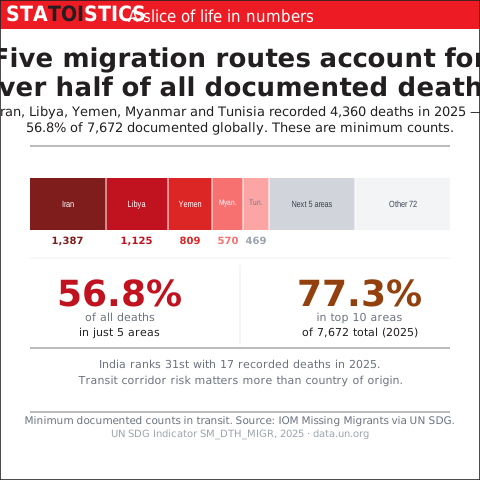
Migration deaths concentration · Youth employment strategy gap · more
H
Human nudge
"Broaden further. Use follow-up ideas from notes.md."
~12 words. The AI had already been documenting its own research ideas in a notes file.
Added: Seed SMTA crop diversity (India #2 globally) · Livestock backup gap ·
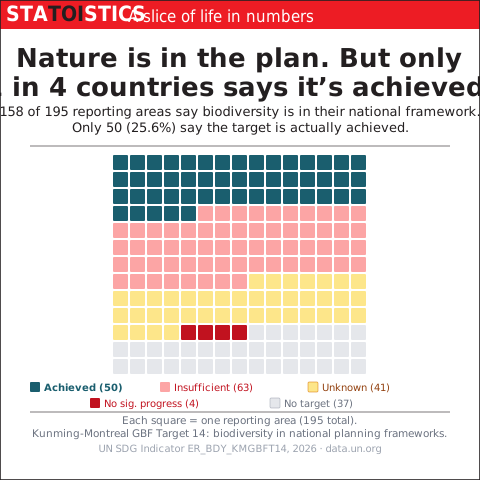
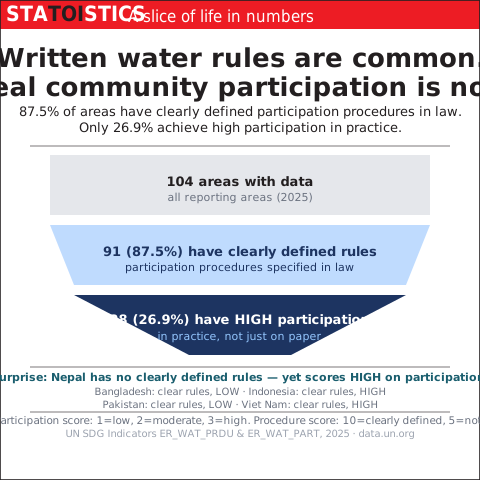
Water law vs actual participation · Biodiversity plan vs reality.
Each lead supported by a reproducible CSV.
The editorial judgment at work
The AI made choices a data editor would recognize.
Take the Ukraine finding. The AI didn't just report that Ukraine has 11,970 refugees
per 100,000 people. It framed it against Afghanistan — a country synonymous with
refugee crisis in public perception — and showed that Ukraine now exceeds that rate.
That reframing is an editorial choice, not a calculation. The AI made it.
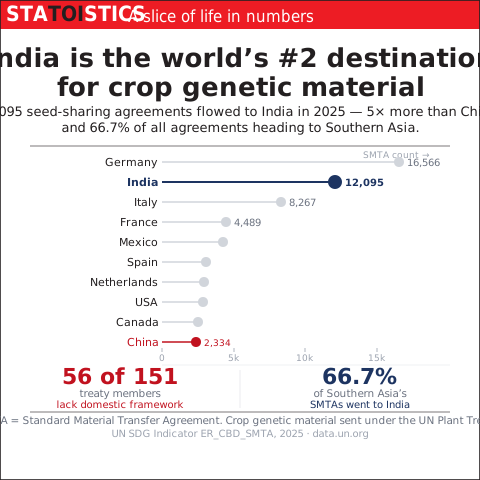
Or take the seed story. Among 15 dataflows and hundreds of indicators, the AI surfaced
a little-known indicator — Standard Material Transfer Agreements — and noticed that India
receives more crop genetic material than any country except Germany. A human analyst
would need to know to look for it. The AI found it by exploration.
Step 3 of 3 · Visualize
From insight to print-ready card — matching the brand spec to the pixel
A data insight is not a published card. Someone has to turn "India ranks 11th in worker
productivity growth" into something a reader will stop and absorb. That means choosing
the right chart type, placing text so it doesn't overflow, matching the masthead font
exactly, and hitting a sub-second print deadline.
Human prompt
Render them as consistent SVGs in the format described by
statoistics-format.md.
Make sure the text, chart, etc. are easy to understand for a lay audience.
Use your judgement on content, style, design elements, annotations.
Save them as 2026-04-14-un-v3/*.svg
~40 words
↓ after one round of human feedback on card #1
AI produced: 10 SVG cards — spec-compliant, pixel-exact ▾
# The Statoistics brand spec the AI had to match:
Canvas: 480×480px, white #ffffff
Masthead: #ed1c24 red, 29px tall
Wordmark: STA[white] TOI[#231f20] STICS[white]
Font: PoynterAgateOne-BoldCondensed 19px bold
transform="translate(6 21) scale(1 1.11)" ← exact positioning
Tagline: PoynterAgateOne-Condensed 15px white
Headline: PoynterOSDisplay-Bold 28px #231f20 centered
Deck: PoynterAgateOne-Condensed 15px #231f20 centered
Border: stroke=#231f20 0.8px rect x=0.4 y=0.4
Footer sep: y=412; Note: y=428; Source: y=443
# Chart types chosen by AI (not specified by human):
Card 01: Barbell/range chart ← shows corridor spread vividly
Card 02: Slope chart ← shows rank surprise
Card 03: Diverging bar ← before/after comparison
Card 04: Peer comparison bars ← India in context
Card 05: Scatter plot ← two-axis outlier story
Card 06: Lollipop chart ← ranked gap data; dots beat bars here
Card 07: Proportional strip ← part-of-whole; shows concentration
Card 08: 4-tier pipeline ← progression from nothing → operational
Card 09: Funnel ← progressive filter (rules → practice)
Card 10: Waffle/unit chart ← 195 squares, one per country
# Size of output:
Total: ~1,270 lines of SVG XML
Largest: card 10 biodiversity waffle = 265 lines
The human gave feedback once — on the very first card. The tagline was too small.
The colour palette needed to be more print-friendly. Three sentences of feedback,
and the AI updated the brand spec file and regenerated everything correctly.
Cards 2 through 10 went out without another round of corrections.
Notice what wasn't specified: the chart types. The human never said "use a lollipop chart."
The AI chose it for card 06 because a lollipop shows ranked data with large gaps between items
more clearly than a bar chart — fewer ink-to-insight wasted pixels.
It chose a waffle chart for card 10 because 195 small squares make the minority of
50 "achieved" countries feel like a minority in a way a percentage never can.
Card 06 · Lollipop — ranked seed-sharing data
Card 10 · Waffle — 195 unit squares by status
Card 07 · Proportional strip — part-of-whole
Card 09 · Funnel — rules vs. practice filter
The trust layer
The AI wrote the fact-checking guide for its own output
There is an obvious problem with AI-generated data journalism: how does a human editor
verify it? The same AI that wrote the insight also wrote the SOP — the
Standard Operating Procedure that tells a journalist exactly how to check every number
before it goes to print.
Each of the 10 cards has a matching verification guide. They follow the same seven-section
structure: how to download the source data, what the card is claiming, the fastest way
to verify it, which exact CSV rows contain the numbers, a card-text-to-source-value table,
and common verification mistakes to avoid.
Human prompt (paraphrased)
Add citations as corresponding .md files alongside the SVGs.
Each should contain enough detail for a journalist to EASILY verify the facts.
Think about HOW they would verify and what to check.
Providing text to search for (via copy-paste) is helpful.
Make this a comprehensive verification checklist and SOP.
↓
Sample SOP structure (Card 06 · Seed Diversity) ▾
## 1. If you do not have the data
git clone --depth 1 https://github.com/sanand0/journalists.git
cd journalists/data/un
uv run download_un_data.py download --match DF_SDG_GLH --latest-only
uv run v3/analyze_un_data.py
## 2. What this card is saying
India received 12,095 SMTA agreements in 2025, ranking 2nd globally.
66.7% of Southern Asia's total. 56 of 151 treaty members have no domestic framework.
## 3. Fastest way to verify
Open: data/un/v3/outputs/seed_smta_country_rank.csv
Filter: rank_high_to_low == 2
Confirm: area_code=356 (India), smta_count=12095
## 4. Exact rows to check
Germany: rank 1, smta_count=16566
India: rank 2, smta_count=12095 ← this is the published number
China: rank 10, smta_count=2334
## 5. Card text → source check
"#2 destination" → rank_high_to_low == 2 ✓
"12,095" → smta_count == 12095 ✓
"5× more than China" → 12095 / 2334 = 5.18× ✓
"66.7%" → india_share_of_southern_asia ✓
## 6. Common mistakes
Do NOT use SI_RMT_COST_SC — contains negative values, unreliable.
Do NOT confuse SMTA sending (source) with receiving (destination).
India is in REF_AREA=356 as recipient, not sender.
## Pre-publication checklist
☐ Confirmed smta_count=12095 in seed_smta_country_rank.csv
☐ Confirmed rank_high_to_low=2
☐ Confirmed treaty_members=151, framework_members=95, gap=56
☐ All numbers round as stated (no silent truncation)
This is the key trust mechanism. AI-generated journalism that cannot be verified by
a human is a liability. AI-generated journalism that comes with a complete verification
trail is an asset. The SOPs mean that a journalist who has never seen this dataset
can reproduce every number in under ten minutes.
Try it: open any card in the gallery, click "Verify,"
and follow the checklist. The numbers hold.
The Full Loop
What the human did vs. what the AI did
H
Human · ~55 words
Prompt 1: "Download all data from data.un.org efficiently."
Plus: be resumable, log progress, use sub-directories. That's it.
AI
AI · 803 lines · ~40 min
Built production-grade async downloader with SQLite state tracking
Discovered SDMX API · 15 dataflows cataloged · Resume-safe · Parallel · Compressed output · Full README
Plus two short follow-up nudges over three rounds. Total human writing: ~120 words.
AI
AI · 1,126 lines · 3 rounds
Ran analysis pipeline three times; surfaced 10 verified story leads
20+ output CSVs · Web research for unexplored angles · Editorial framing for each insight · notes.md of caveats and follow-ups
H
Human · ~40 words + 3 sentences of feedback
Prompt 3: "Render as SVGs following statoistics-format.md."
Gave feedback on card #1: tagline too small, use print colours. ~3 sentences total.
AI
AI · ~1,270 lines SVG · pixel-exact
10 brand-compliant SVG cards with appropriate chart types
Chose chart types independently · Lollipop, waffle, funnel, proportional strip — each matched to the story's data shape · Rendered PNG for visual QA · Fixed own errors
H
Human · ~30 words
Prompt 4: "Add verification SOPs for journalists."
Specified the checklist format. That's all.
AI
AI · 10 SOPs · ~4,000 words
Wrote 7-section fact-checking guide for every card
Exact CSV row filters · Copy-paste search strings · Pre-publication checklists · Common pitfall warnings · Reproducible data pipeline instructions
So What?
A newsroom function just got automated. Not replaced — automated.
There is a difference between a tool that helps a journalist work faster and a system
that can run an entire pipeline from raw data to published card with minimal human input.
This is the second thing.
The human in this workflow didn't know SDMX format. Didn't write SQL. Didn't design a chart.
Didn't calculate a percentage. Didn't pixel-check a font size.
What the human did was something harder to automate: decided what mattered.
"Find the surprising angles. Write for lay readers. Make it verifiable."
Those are editorial judgments, and they guided everything.
"The workflow scales. Point it at any structured dataset — MOSPI, RBI, NFHS — write
four prompts, and the machine produces the same pipeline: download, analyze, visualize, verify."
We tested exactly this. The same process produced
7 cards from India's PLFS survey and
5 cards from PLFS v4 before the UN work began.
The prompts were nearly identical. The outputs were equally publication-ready.
What changes when this becomes routine? Data stories that currently take a week of
journalist-plus-designer time now take an afternoon — and the human spend that afternoon
on the editorial judgment, not the plumbing. The machine handles the plumbing.
What this is not
It is not autonomous journalism. Every card in this gallery was published because a human
editor decided it was ready. The verification SOPs exist precisely because the AI's
output needs a human check before it goes to print. The editorial voice — the decision
to compare Ukraine to Afghanistan, to focus on India's seed-diversity rank — came from
a person with journalistic judgment.
What AI automates is the distance between "I have a dataset" and "I have something
a journalist can read and verify." That distance used to take weeks. Now it takes hours.