In a small ashram, deep in the heart of India, a spiritual teacher once wrote a sentence that would change the way Rajen Makhijani viewed the world. The sentence was disarmingly simple, yet it carried the weight of a fundamental truth: "An experience is to life what a brick is to a wall."
We often think of our lives as a single, coherent narrative—a monolith of identity and achievement. But if you look closer, as Makhijani did, you realize that the wall is only as good as its individual bricks. If you want a life of well-being, you don't look at the wall; you look at the bricks. You look at the net happiness of each individual experience.
Rajen Makhijani is not your typical spiritual seeker. He is a Client Partner at Korn Ferry, a man who navigates the upper echelons of corporate leadership and organizational strategy. But he has spent much of his career—and his life—trying to traverse what he calls the "glass wall of class." It is a divide that most of us never even realize exists until we press our noses against it.
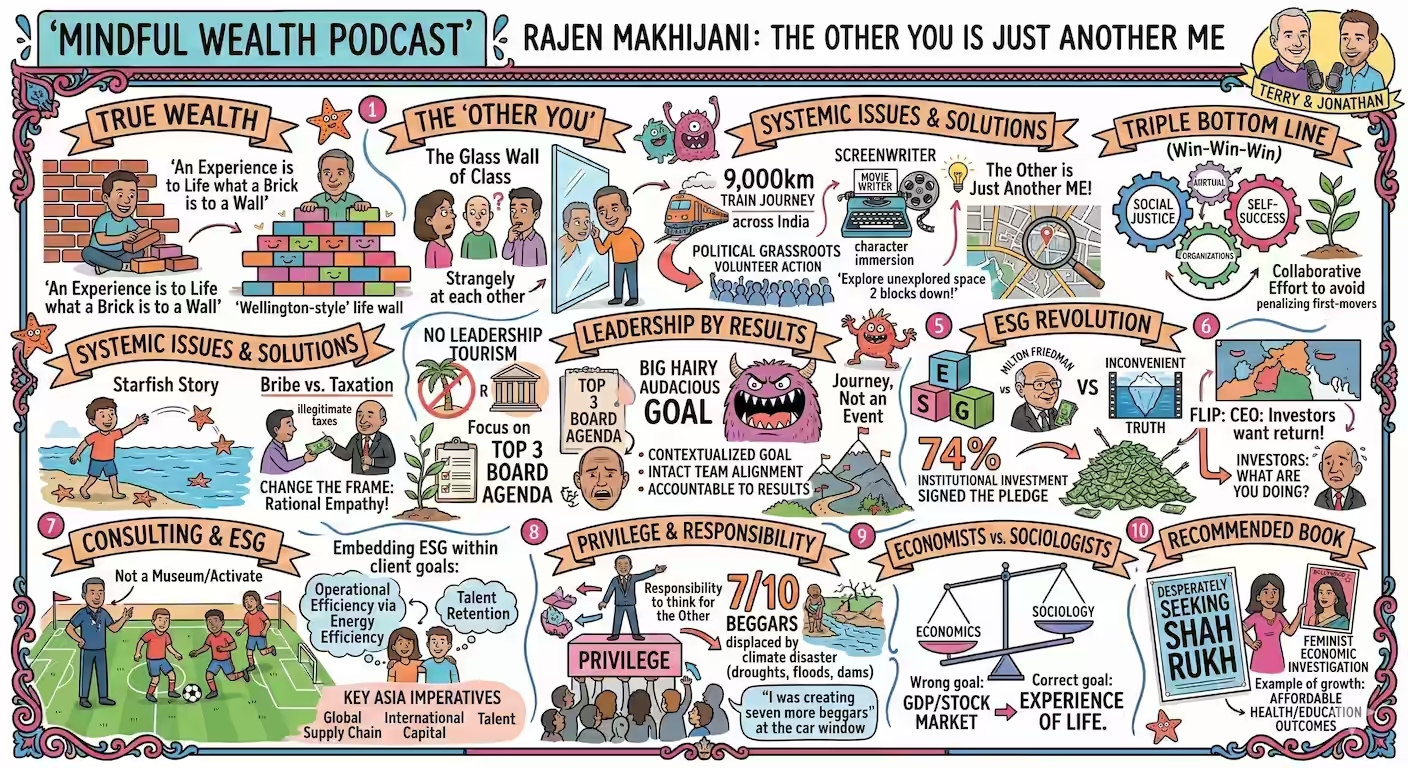
The "Other You"
In his TEDx talk, Makhijani introduces a concept that is both uncomfortable and profound: the idea that there is an "other you" on the other side of that glass wall. We look at the poor, the uneducated, or the marginalized as if they were a different subspecies. We judge their choices. We wonder why they do what they do. We say, "If only they made different choices."
To understand this context, Makhijani didn't just read about it. He immersed himself in it. He took a 9,000-kilometer train journey across India, living among people whose lives were fundamentally different from his own. He became a screenwriter to learn how to see life from characters' points of view. He volunteered for an Obama-like political campaign to understand the grassroots reality of the masses.
What he found was a staggering rationality hidden behind what looks like irrationality. Take, for instance, the concept of bribes. To a Western investor or a real estate developer, a bribe is a moral failing, a sign of corruption. But for those on the other side of the glass wall, Makhijani argues, a bribe is often just a tax by another name. They are paying for the same goods and services we are, but they are paying a much higher price—and their payments aren't even accounted for.
The Corporate Conscience
This empathy isn't just a personal philosophy for Makhijani; it's a business imperative. As the APAC Co-Leader for ESG (Environment, Social, and Governance) at Korn Ferry, he is at the forefront of a revolution that is flipping the script on corporate responsibility.
For decades, the Milton Friedman doctrine ruled: the business of business is profit. But as Makhijani points out, that doctrine relied on the myth of "perfect markets." In reality, the market doesn't price in "externalities" like climate change or social inequality. Today, $30 trillion in institutional investment money has signed up to the pledge that they won't invest unless ESG considerations are met.
"Investors are now saying to management, 'What are you doing about this?'" Makhijani notes. It's no longer just about heart and compassion; it's about risk. If your business model relies on sweatshops or polluting the environment, you are a risky bet.
Leadership by Results
Makhijani advocates for a framework he calls Leadership by Results. It's a way of moving leadership away from "tourism"—sending people on courses to meet new people—and toward actual impact. It involves three steps:
- Contextualization: Aligning leadership to a top-three board-level goal (revenue, successor pipeline, digitizing, or social impact).
- Team Alignment: Seeing leadership not as an individual sport, but as an intact team working toward a "big, hairy, audacious goal."
- Accountability: Staying accountable to the actual results, not just the activity.
The Cost of Progress
Perhaps the most sobering part of Makhijani's narrative is the human cost of our "development." He cites a shocking statistic from Booker Prize winner Arundhati Roy: seven out of ten beggars at traffic lights in Indian cities are displaced by man-made disasters—dams, deforestation, and "climatic disasters" perpetrated by the very progress we celebrate.
When a consultant proposes a hydropower project to generate electricity for factories, they are creating economic prosperity for some. But their "frame" often fails to account for the people they are turning into beggars. The " nuisance" knocking at your car window might be the direct result of the presentation on your laptop.
"It's a privilege and a responsibility," Makhijani says. "Because the 'other' doesn't have that privilege, I have to make sure that the systems that I and my forefathers have perpetrated... I need to be thinking on their behalf as well."
Economics as Sociology
In the end, Makhijani's message is a call to redefine our metrics of success. If the only currency we understand is market cap and GDP, we are "shooting slightly right of the goalpost." We should be measuring the experience of life we are generating for humanity.
He recommends a fascinating book by World Bank economist Shrayana Bhattacharya, Desperately Seeking Shah Rukh. It's an investigation of the economy through the eyes of Indian women and their love for movie star Shah Rukh Khan. It shows that growth isn't just about higher income—it's about whether that income leads to better education, health, and freedom for the family. Growth that results in an alcoholic husband is not growth.
Rajen Makhijani reminds us that the glass wall is fragile. It can be bridged by empathy, by perspective-taking, and by a refusal to see the world as "us and them." Because once you look through the glass, you realize that the person on the other side isn't a subspecies. They are just another you, building their wall, one brick at a time.