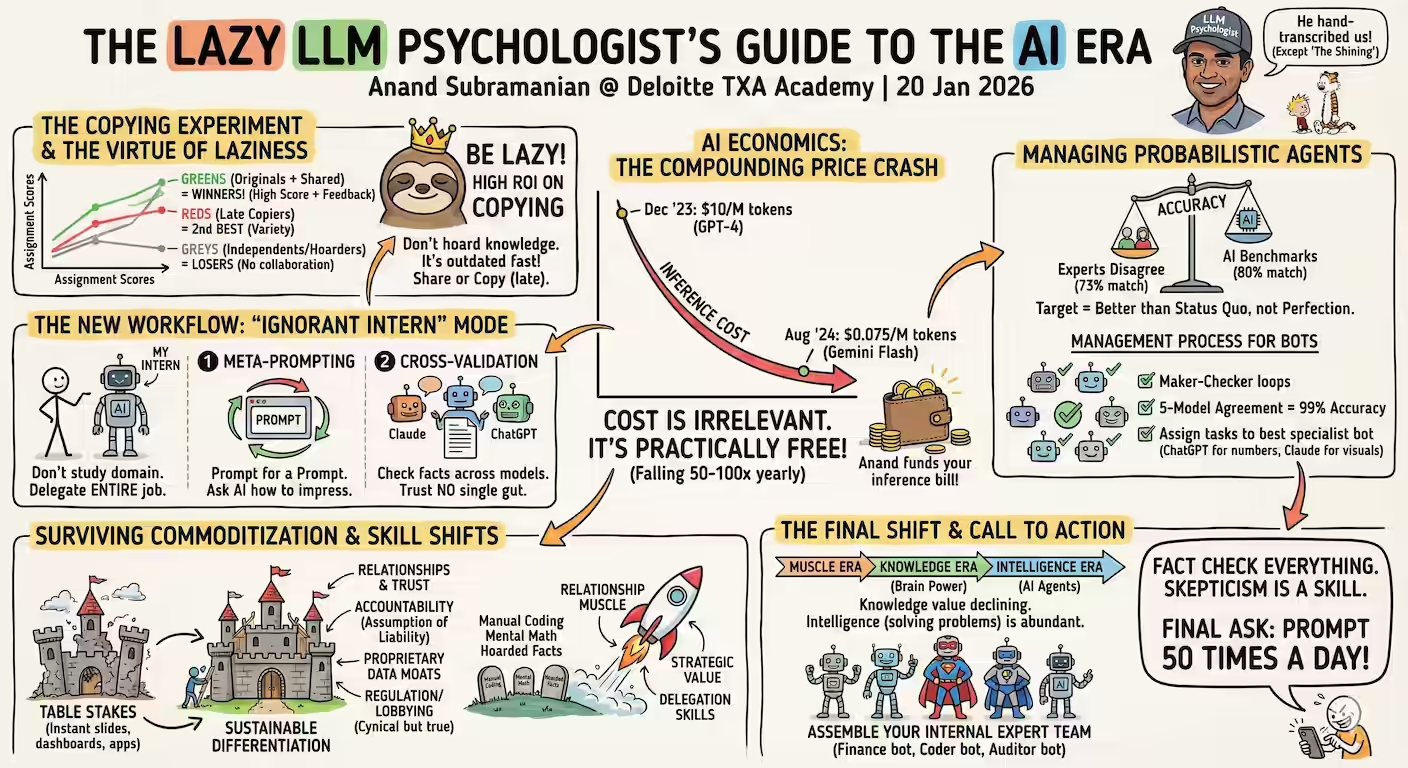
Here is a fact that will confuse you: at IIT Madras, one of India's most prestigious engineering institutions, a professor recently told his students they were allowed to cheat. Not just tolerated. Explicitly, enthusiastically encouraged. "You can copy. Feel free," Anand told them. "Cheating is allowed." And then he did something no one expected—he measured what happened next.
This is the story Anand, LLM Psychologist at Straive, opened with when he stood before a room of senior consultants at Deloitte's TXA Academy on January 20, 2026. It wasn't the opening anyone expected for a session titled "Agentic AI in Action." But then, nothing about this talk went the way anyone expected.
The introduction alone set a tone of controlled absurdity. The host described Anand as one of India's top 10 data scientists, an alumnus of IIM Bangalore, IIT Madras, London Business School, IBM, BCG, and Lehman Brothers—an institution that no longer exists, which is its own kind of credential. But the detail that drew the most reaction was personal: Anand has hand-transcribed every Calvin and Hobbes strip ever published. This also earned him a Digital Millennium Copyright Act takedown notice, which he delivered with the nonchalance of someone who considers being sued a résumé enhancement.
And then there was The Shining. He watches every film on IMDb's top 250—except that one. "I read the book, and I've seen Jack Nicholson and Stanley Kubrick separately," he explained. "I can't combine them."
The room laughed. And then Anand did what Malcolm Gladwell does with airplane disasters and ketchup—he took something seemingly trivial and turned it into a lens for understanding everything else.
The Taxonomy of Cheaters
The coding assignment at IIT Madras wasn't an accident. It was an experiment in the economics of collaboration. Anand could mathematically determine how similar any two submissions were—character-to-character matching, adjusted for various thresholds. Even at a generous 40–50% similarity threshold, only about 40% of students were copying. Which raised the first surprising question: when cheating is explicitly permitted, why don't more people do it?
But the more interesting question was about the taxonomy. Anand divided students into four groups:
"What's your guess?" he asked the Deloitte room. "Who scores the highest?"
The audience voted overwhelmingly for the Reds. The rational thieves. The patient plagiarists who waited until the best work was published and then cherry-picked. It's the answer any consultant would give—arbitrage through late-mover advantage.
They were wrong.
The Greens—the people who created original work and let others copy it—outperformed everyone. The logic, once Anand explained it, was devastating. When you share your work, two things happen. First, you receive feedback. Early feedback. Your work improves. Second, you learn from how others adapt what you shared. "Part of what gets copied becomes yours."
The Reds came second. The Yellows—who copied early, from a smaller pool—did poorly. And the independents? The Greys, sitting in their own silo, developing solutions in isolation, neither sharing nor borrowing?
Dead last.
The audience laughed. But the deeper lesson was aimed squarely at a consulting firm built on proprietary knowledge: intellectual property through propriety is one strategy. Learning through collaboration is another. In this experiment, collaboration won.
The Confession of Laziness
Having established that copying is virtuous, Anand pivoted seamlessly to the topic at hand. But he did it through a confession.
"See, I'm lazy," he said. "I absolutely cannot do work."
This is the kind of statement that, from most speakers, would be self-deprecating charm. From Anand, it was a manifesto. When his contact at Deloitte, Ramya, called to brief him on the session, he didn't take notes. He took a transcript of the call and fed it into Claude and asked, "What am I supposed to do for this?"
The entire pre-work—questions, survey design, quiz creation—was dictated during a walk. "I didn't bother typing all of this stuff," he said. "All of this is dictated while on a walk. Why waste time when walking?"
This was not humility. It was pedagogy. Laziness, in Anand's formulation, is not the absence of effort. It is the redirection of effort. Every minute spent not doing something an AI can do is a minute available for something only a human can do—like building trust, or asking the right question, or being the person the client calls first.
The Hype-or-Reality Quiz
Before the session, attendees had filled out a survey. The questions were themselves produced by AI—Claude generated them based on Anand's dictated brief, then cross-validated the answers through deep research.
One question: "AI agents can now autonomously negotiate and close binding procurement deals for tail spend categories without human intervention." Hype or reality?
In the room, almost nobody believed it was real. They were wrong—or at least, not as right as they assumed.
The technique was already the lesson. Don't rely on one model. Don't rely on your own knowledge. Cross-validate. And more importantly: don't assume you know the landscape of what's possible. "This thing changes so quickly that knowledge is not worth hoarding. Yet another reason to share what you know, because it's anyway out of date. You're selling old stock."
The Intern Principle
And then came the audience exercises—the part of the talk that turned theory into visceral experience.
The scenario: a client has conducted a survey of their senior leaders about which AI capabilities are reality and which are hype. They have an executive meeting tomorrow. They want Deloitte to come in and present an advisory. How do you approach this?
The first volunteer reached for the familiar playbook: use Deloitte's internal tools, understand the data, build a baseline, layer on the firm's expertise. Solid, methodical consulting. Anand praised it warmly.
A second volunteer offered something more sophisticated. Two techniques: meta-prompting—using ChatGPT to generate a better prompt—and cross-validation—feeding the output to Gemini or DeepSeek for a second opinion. Anand's eyes lit up.
"Which is a great starting point in 2025," Anand said thoughtfully. "In 2026, we would do it slightly differently."
And here is where the talk shifted. The 2025 approach is: I will learn, then I will deliver. The 2026 approach is: I will not learn. The AI will learn. The AI will deliver. I will review.
Anand described his Innovation Team at Straive—two to four freshers who produce two to four prototypes daily. "These people don't understand the domain. Some of them don't know how to code. I mean that. They actually are not coders either. What skill do they have? Nothing."
A third volunteer came forward and dictated a prompt: "Please analyze the data that has been recorded from the survey. Give me top three trends out of it. Summarize the survey in a manner which is presentable."
Anand treated this like the raw material it was. He pasted the prompt into Gemini—not Claude, not ChatGPT, Gemini. Why? Practical arbitrage. "ChatGPT has fantastic voice recognition. Gemini is much faster than ChatGPT. If I sit and run ChatGPT, it will give a perfect answer 30 minutes after the end of the presentation."
And then, a devastatingly casual admission: "I ran out of Claude credits because I was sitting and coding there."
The audience laughed. But the deeper point was already in motion. Anand was demonstrating live the principle he was teaching: treat AI like an intern. Give it the whole job. "Why are we standing in the middle trying to interpret it almost like a man in the middle?"
The Art of Not Reading
This was the moment the talk became genuinely subversive. Most AI demonstrations show you how to use AI more effectively. Anand was showing something different: how to use AI without even looking at what it produces.
"Now, there are two ways in which we normally approach this," he said. "One: read it, understand it, share it. Second approach: don't read it, don't understand it, just share it. Both are valid."
The room stirred. This is not advice you hear at consulting firms. Consultants are trained to understand everything before they present it. Anand was proposing something that felt reckless—until he unpacked it.
"You have a lot of practice in the reading/understanding side," he continued. "Practice the not reading, not understanding side also. Copy. Cheat."
The logic was paradoxically rigorous. If the AI can produce an analysis that is 70-80% as good as what you'd produce after hours of study, and you can produce it in minutes instead of days, the remaining 20-30% gap can be closed by meta-prompting—having the AI improve its own output. Why would you put yourself in the middle of a process that can run without you?
The Presentation That Built Itself
While the audience watched, Anand composed a meta-prompt on the fly—dictating to ChatGPT, then feeding the improved prompt to Gemini with the survey data. The meta-prompt itself was a masterclass in delegation:
And then, pivoting to create a slide deck, he pulled up a prompt fragment from his personal prompt library: "Convert this into a beautiful slide deck—McKinsey style. Make the slides content-rich, self-explanatory with enough detail so that it can explain without a narrator, and write it as a single-page HTML application."
The results appeared while the audience watched. Your overall accuracy as a group: about 70%. The most contested question: AI supplier onboarding—a near 50/50 split. Almost everyone correctly identified deepfakes as a threat. "One person did not identify deep fakes as a threat," Anand noted. "You know who you are."
But the most potent insight emerged from the pattern across all responses: security threats and regulatory landscapes—areas consultants know well—were easy. Emerging capabilities were where the group stumbled. "If it's a new area, don't trust your gut. Check. Verify. It is more likely that AI will have a better point of view than you."
The Falling Price of Intelligence
Nearly 45% of the room believed that inference costs remained a barrier to AI adoption. Anand demolished this assumption with a visualization that told one of the most dramatic price-collapse stories in the history of technology.
In December 2023, GPT-4 was the best model available. It cost about $10 per million tokens—roughly the price of summarizing the entire King James Bible. By August 2024, Gemini 1.5 Flash delivered the same quality for 7.5 cents. "Not $10. Not $1. Not 10 cents. 7.5 cents for the same. That's less than one-hundredth."
The implication landed like a quiet bomb: "The difference between a $1 million budget and a $10,000 budget. Same work."
The cost trajectory was so extreme that Anand made a claim that sounded absurd until you did the math: "I tell our clients: I will personally fund your entire inference bill. As long as I can build the solution." Not a hypothetical. A literal offer. Out of his own pocket. Because at current prices—and with costs falling 50 to 100x annually—the cost of intelligence has become negligible.
The Prompt Gap
Anand had asked the attendees to submit prompts as part of the pre-work. Then he fed the prompts themselves to AI and asked it to evaluate them.
The headline was blunt in a way that only McKinsey-formatted AI can be: "A significant skill gap exists in AI prompting." Anand's aside: "You can't put a McKinsey slide without the word significant in the title."
Only 18% crafted high-quality prompts. The biggest gap? Context and Persona—failing to tell the AI who it is and who the audience is. "Which is," Anand observed, "a classic management mistake that we all make. I tell my team members: look, just get this done. Not 'I have a meeting with this particular person, this is what I'm trying to achieve, therefore get this done.' It's two more sentences, but it's easy to forget."
The second gap was structural clarity—specifying the exact output format. The good news: the group was strong on defining KPIs and requesting actionable insights. The meta-lesson: you don't need to learn prompt engineering. You just need to meta-prompt. Have the AI improve your prompt.
The Death of "Think Step-by-Step"
And then Anand detonated a small bomb under the entire prompt engineering industry.
He'd tested various prompting strategies across dozens of models. Emotion prompting—"My life depends on it!"—made 21 models worse. Politeness hurt 20 models. Fear hurt 19. Only one strategy consistently outperformed: reasoning—the simple phrase "Think step-by-step."
That was a year ago.
"Today, 'think step-by-step' hurts more than it helps." The room went quiet. Why? Because the AI providers read the same research, incorporated it into their models and inference harnesses, and now applying it externally is redundant at best, counterproductive at worst.
This was the lesson behind the lesson: prompt engineering is a moving target. What worked six months ago may actively hurt today. The only durable strategy is testing, not knowledge.
The Hallucination Solution
The inevitable question arrived, dressed in the language of enterprise risk management: AI results are probabilistic, not deterministic. In a client production environment, that could be fatal. So how do you deal with it?
Anand answered with data. A client in research paper tagging complained that AI accuracy didn't match expert accuracy. Anand asked the obvious question nobody thinks to ask: how well do your experts agree with each other?
"The answer was about 73%. AI was matching them at about 80%."
The target shifts once you set the benchmark correctly. It moves from "machines need to be perfect" to "machines need to be better than status quo." And then: how do you make them better?
The answer is embarrassingly simple: use more models. One random model on a classification task: 14% error. Two models that must agree: 3.7%. Five models: less than 1% error. The catch? When models disagree, a human reviews. But with five models, disagreement occurs only 28% of the time.
The profound reframe: "The strategies for dealing with hallucinations are not very different from the strategies of management processes." Maker-checker. Peer review. Debate until consensus. Break the task into parts and assign each to the best-suited agent. These are not new ideas. They're ancient management techniques, applied to infinitely cheap labour.
The Question That Haunted the Room
Then a question arrived that cut through the technical demonstrations straight to the existential anxiety underneath. A senior consultant stood up and asked, essentially: If AI can do everything we just saw, why does the client need Deloitte?
"Good question," Anand said. "Something that I struggle with every day."
He didn't answer from expertise. He asked Gemini—live, in front of the audience. He paraphrased the question, added context, specified the output format, and ran it. Because of course he did. He was practicing what he preached.
But then he offered his own view, and it was unexpectedly specific:
Making friends with your clients. That's the moat. "Arguably, what was I doing as a consultant at BCG? I was taking some junk which anyone else could have done and sharing it. The reason the clients were buying it was because the partner was friends with the client."
Two more: proprietary data integration—owning unique training data, prompt libraries, validation datasets—and assumption of liability. "If we go wrong, we will stand by you. We will fight your cases for you. We will guarantee success monetarily, legally, however we want."
Knowledge is not a moat. Relationships, data, and accountability are.
The Calculator Analogy
Another senior consultant pressed further: won't skills atrophy? In the early days, she said, figuring out undocumented Oracle functionality by trial and error produced knowledge that lasted decades. Junior practitioners today skip that process entirely. How do you strike a balance?
Anand's answer echoed something he'd clearly thought about deeply:
If it's becoming less important—and coding, domain knowledge, and routine analysis are all declining in value—let it go. The way we let go of mental arithmetic when calculators arrived. The way we let go of navigation skills when GPS arrived. The skill loss was real. The trade-off was worth it.
But if the skill is growing in importance—and relationships are, because AI is absorbing the intellectual labor—then invest there. "Which was actually my intent in that copying exercise," Anand said, closing the loop beautifully. "Not only do you learn to copy, you learn to make friends. Do you have any one person even whom you can reach out to and say, 'Let me copy your assignment'? And if you don't have even one person and don't know how to build that skill, in the AI era you have a problem."
The GDPVal Wake-Up Call
Toward the end, Anand pulled up the visualization that had reshaped his own financial decisions: OpenAI's GDPVal study, where experts designed tasks, both experts and AI attempted them, and experts judged.
Green meant AI outperformed experts. The treemap was overwhelmingly green. Software developers. General managers. Customer service. Personal financial advisors.
Anand's response to the personal financial advisors result was characteristically pragmatic: "Personal financial advisors seem to be doing worse than humans. Very good. I had some money." He went to ChatGPT. Got advice. Followed it. "My largest investments have been after I saw this."
The broader point: for free, you now have a software developer, a customer service rep, a financial advisor, a medical manager. "Earlier we would be constrained. 'Oh, I don't know a person with this kind of skill.' Now you do. 'Oh, but they cost money.' Now they don't. 'Oh, but I don't have the time.' Yes, you do."
The Knowledge Trap
Anand landed his closing argument with the precision of someone who has delivered hundreds of talks and knows exactly which line will echo longest.
There was a time when what you could lift was your asset—the industrial age. Then came the knowledge era, where what you knew was your edge. Then the internet eroded knowledge, but intelligence—the ability to solve novel problems—retained value.
"But now we have something that is solving the problem. I don't know what's going to replace it."
His prescription was deliberately paradoxical:
- If you know how to figure out the answer, don't figure out the answer. Have an AI figure out the answer.
- If you know the answer, don't say the answer. Have the AI find the answer.
Why the second? "Because your knowledge is probably outdated. You may be biased. And you have an intelligence that can cross-question."
Why the first? "You're wasting time applying a skill that could instead be spent on learning a new skill, which is delegating to AI agents."
And then the final line, delivered with the conviction of someone who has bet his career on it:
He paused. The room was silent. And then, the ask:
"I have only one ask of you: Prompt 50 times a day."
The Standing Ovation
What made this talk unusual wasn't the technology—every consultant in that room had heard of ChatGPT. It wasn't even the techniques, though meta-prompting and cross-validation were new to many. It was the posture. Anand had walked into one of the world's largest consulting firms and told them that their most valuable skill wasn't expertise—it was the willingness to not know. That ignorance, properly leveraged, was a superpower. That laziness, properly directed, was strategy.
He had started with a story about cheating and ended with a story about relationships. He had told them to stop reading and start delegating. He had demonstrated, live, that a survey could be analyzed, visualized, and presented in the time it takes to have a conversation about how to approach the problem.
And hovering beneath all of it was a question that nobody asked aloud but everyone heard: If a team of freshers with no domain knowledge and no coding skills can produce four prototypes a day, what exactly am I being paid for?
The answer, Anand suggested, is the one thing AI can't do: be the person the client trusts. Be the person who takes accountability. Be the Green in a world of Greys—the one who creates, shares, receives feedback, and comes out ahead.
Be lazy about everything else.