AI for Institutional Advancement · IIT Madras · 18 March 2026
The Office That Learned to Crack the Whip
What happens when an LLM Psychologist walks into IIT Madras's fundraising office and starts live-coding in front of a team that manages ₹320 crore in annual giving?
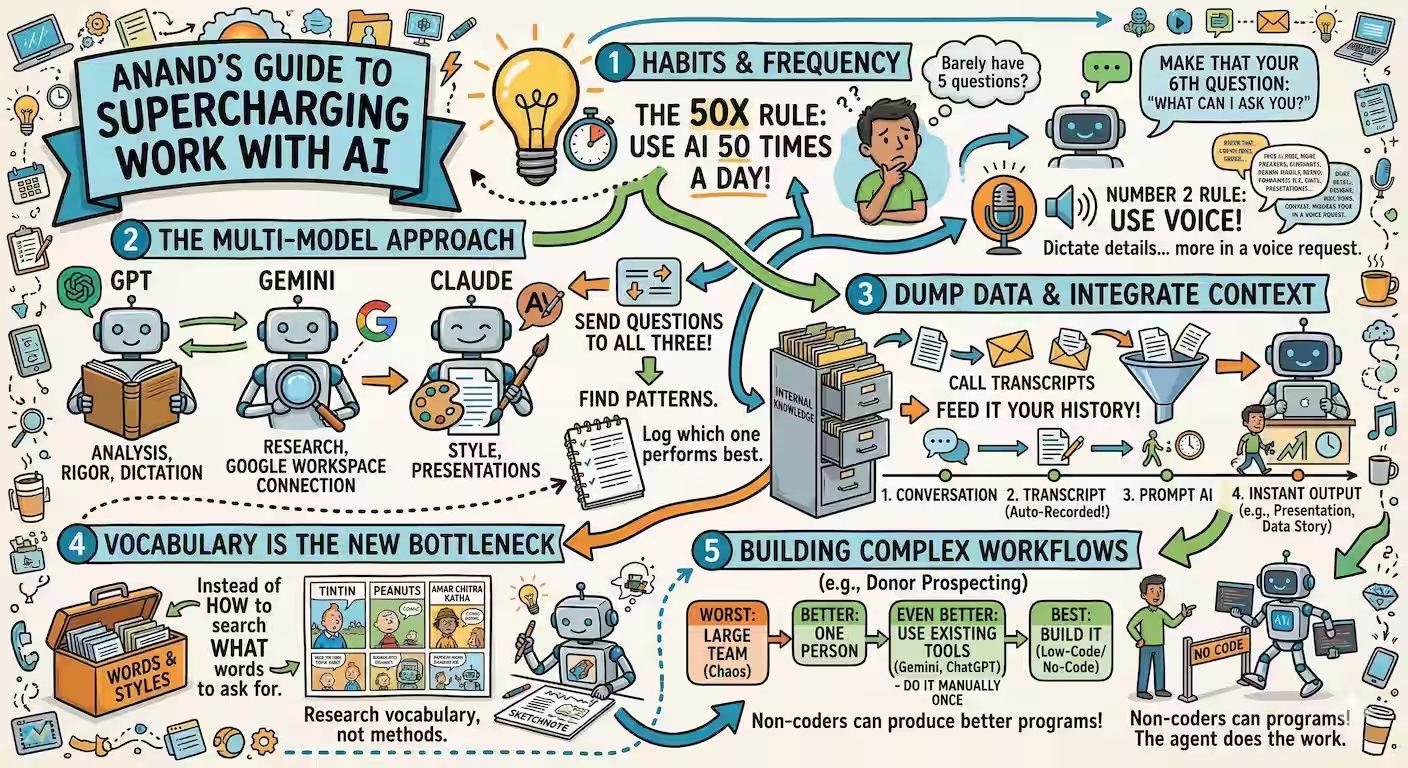
✏️ Sketchnote — click to open full size · Generated with Gemini Pro
On the morning of 18 March 2026, Anand S. walked from the car park to the Office of Institutional Advancement at IIT Madras. He didn't prepare a deck. He didn't rehearse talking points. Instead, he dictated — into ChatGPT's voice interface, while walking — a rambling, stream-of-consciousness brief about who he was about to meet, what they did, what they worried about, and what surprises might be useful to them. By the time he reached the door, the AI had already drafted a list of use cases for the team. The talk had essentially prepared itself.
This is the kind of thing that sounds implausible the first time you hear it. It sounds less implausible the second time. And by the third time, it starts to feel like the obvious question is: why isn't everyone doing this?
The Office of Institutional Advancement is not a small office . It is IIT Madras's fundraising and relationship engine — the team responsible for building partnerships with alumni, corporations, foundations, and trusts. In 2024–25, they raised ₹320 crores. They manage 55,000+ alumni across 82 countries. They run 1,500+ projects, stewarding donors who give anywhere from a few thousand rupees to, as one team member described that day, a crore — or five hundred.
This is, in other words, a team that lives and dies by relationships. High-touch sales. Careful profiling. The kind of work that is deeply human, deeply personal, and — as the session would reveal — surprisingly, powerfully amenable to AI.
The Scale of What OIA Does
₹320 Cr
raised in 2024–25, including ₹195 Cr under CSR
55,000+
alumni engaged across 82 countries
1,500+
active projects on Joy of Giving platform
140+
corporate partners in the network
The Rule Nobody Follows
Anand, who holds what may be the world's most unusual job title — "LLM Psychologist" at Straive — did not begin with a lengthy preamble. "The content is more important than introductions," he said, declining a formal introduction. He dove straight in.
And his first point was a number: fifty.
"The number one rule that I am suggesting is: use ChatGPT or whatever — Gemini, Claude, whatever — fifty times a day."
— Anand S., LLM Psychologist, Straive
The room, naturally, pushed back. "But I barely have things I can ask it five times a day."
Anand was ready for this objection. He always is, because it is the objection.
"Very good. Then make this your sixth question: 'What can I ask you?'"
— Anand S.
This is not a trick. It is the crux of everything that followed. The bottleneck to using AI well, Anand argues, is not intelligence or technical skill. It is the absence of a reflex — the habit of turning to the machine before you turn to Google, before you turn to a colleague, before you sit quietly and wonder .
The second rule followed immediately, and it was, if anything, even more important:
"Use voice. There is just so much you can put into a voice request."
— Anand S.
Voice is underrated . We type more carefully than we speak, which means we censor, compress, and strip away context. When you dictate — while walking to a meeting, while grabbing lunch, while waiting for a Zoom to connect — you speak in full sentences, with full context. (Anand documented this entire workflow in Voice Chat to Slides.) You mention the name of the person you met, the thing they said that surprised you, the vague feeling that something is off about the proposal. The AI can work with all of that. A typed query often can't capture it.
How the 50-Conversations Habit Works
The 50-conversations loop — building the reflex over days and weeks
The Talk That Prepared Itself
Here is what Anand actually did, that morning. He had a call the previous day with two members of the OIA team — a preparatory conversation about what the team needed. His phone auto-records calls. A transcript was automatically generated. And while walking to the session, he fed that transcript to an AI agent — along with his blog posts, his notes, his past transcripts, his own writings on AI — and asked it to figure out the most useful things he could share with this specific team.
"Here is all the Google Drive of material about me. Use the combination and create something that I can deliver for them."
— Anand S., describing his pre-talk preparation workflow
The result was a web page — a full set of AI use cases for the OIA, generated entirely from the combination of one call transcript and Anand's accumulated notes. It was ready before the meeting began.
🔧 The Process
Anand used a structured prompt (dictated while walking) to instruct an AI agent to: research the OIA team, read the prep-call transcript, scan his blog and past transcripts for relevant tips, then produce an ideas file. A second prompt converted that into ideas.html — a shareable web page ready before the meeting started.
Explore the Use Cases
Before this session, Anand generated a comprehensive set of AI use cases tailored for IIT Madras's Office of Institutional Advancement — from meeting intelligence to donor stewardship at scale. Explore them here.
14 detailed ideas · sourced from Anand's blog, transcripts & notes · generated with AI
The Experiment, Live
Once seated, Anand opened his laptop and did something almost no speaker does: he ran an experiment in front of the audience, with no predetermined outcome.
"I'm discussing with the IIT Madras team that's focused on, among other things, funding. Now, just search online and tell me what are some interesting use cases for them." He typed this into Claude, Gemini, and ChatGPT — simultaneously.
"Why bother sending it to one? Send it to three. If one of them does a better job, and I find that it does a better job ten times, then great — I will use that more."
— Anand S.
This is the pattern Anand practices obsessively. He keeps notes — in Visual Studio Code, though he was quick to add "you can use Excel, use whatever you want" — of which model does better on which type of question. "I asked, 'How does an innovator build accountability?' And I found that Sonnet did a better job than GPT-4, looking down on Gemini 3." Over time, he compiles the comparisons, feeds them back to yet another model, and asks it to synthesise: what is each model good for?
"The bottleneck to fifty conversations a day is not that we don't have ideas. It is that we are not trained on asking for ideas when we don't have ideas."
— Anand S. · IIT Madras, 18 March 2026
A team member asked: does it matter that I have a cluttered history? Won't all those random questions mess up its memory of me?
Anand's response was not "no, don't worry." It was a masterclass in meta-thinking:
"This is exactly the habit that we need to build. We have a question — immediately ask. You're asking me — that's valid. But also ask it."
— Anand S.
And then, on the question of cluttered memories: "You can clean up memories. You can tell it what to ignore. You can ask it to do an audit. If it says 'I can't automatically delete,' you say 'I still want to automatically delete — write me a program.' It will write the program. If you can't run the program, it will tell you how. And if you still can't, stop, give up, move on — because the number of things you can do is infinite."
The Demonstration That Prepared Itself
The team had received a rich list of use cases from Claude, Gemini, and ChatGPT before the session even started. But Anand now showed how those links were generated — by walking them through the live sessions he had shared.
Send every interesting question to all three simultaneously — then compare and log the winner
Cracking the Whip Without Writing Code
Anand is not, in any meaningful sense, the person who builds the things he demos. He says this openly. "It's Greek to me," he told the team, when asked about the code ChatGPT had just written. The code was irrelevant. The result was what mattered.
He has a philosophy about this that he articulated with deliberate provocation.
"People who don't know how to code can produce better programs than people who know how to code — because they will stupidly try and interfere with the agent, and the agent can do a good job."
— Anand S.
He gave a concrete example. When he needs an urgent client demo built, he doesn't go to his senior engineers. He goes to interns.
"Do not apply your brains, you do not have any. Take that, give it to a coding agent. At the end, use your some validation muscle. Do one basic filter. Show me. If I like it I'll take it, if not I'm not even going to give you feedback. I'm going to drop it. Because cost is nothing. You're just dictating and reviewing. You can do that ten times."
This is not cruelty. It is a precise description of how AI-assisted work functions at its best. The experienced engineer brings assumptions about how code should be structured. The intern brings a question: "What do you want it to do?" The AI provides the structure. Experience, in this model, is a constraint.
The Synthetic Data Trick
The team's Kaviraj asked a question about attendance data. They had records in Zoho. They wanted to analyze patterns — who attended events, who converted to donors, which channels worked. But the session wasn't the right moment to share live sensitive data.
Anand's solution: don't use real data. Don't even have it.
"I'm doing a demonstration of how we can analyze attendance data for insights. I don't have data. I still want to run the demo. I will ask for data."
— Anand S.
He typed a prompt into ChatGPT: generate a rich, realistic synthetic attendance dataset for an institution like the IIT Madras Office of Institutional Advancement. Include alumni IDs, event attendance, check-ins, donation history, city of residence. Make it realistic — with the kinds of patterns you'd actually find in such data.
Within minutes, a CSV file materialized. He downloaded it. Then he fed it back to ChatGPT with an analytical prompt that he had clearly been refining for years:
📋 The Analysis Prompt
"I have uploaded the attendance data. I'm not sure what to analyze for — so if I were leading this team, what kinds of useful insights might I want? Analyze accordingly. Tell me the most actionable, surprising, non-obvious insights. Begin with a crisp executive summary of one to three bullet points of what I should do. Then go into all the details."
A team member watched the output scroll by and said: "Wow. The prompt itself is very clear on what I can get."
Anand was characteristically self-deprecating about where the prompt came from:
"This is not coming as much from a deep thought as from frustration. I've seen very, very dumb analyses that people give. And this is basically all of the stuff I've been telling twenty people for the last twenty years about what not to give me — dumped in here. Dump your emotions into it."
— Anand S.
The synthetic data analysis came back with four recommendations. All four were sensible. One in particular caught the team's attention: "Fix RSVP forecasting — a significant number of people who said 'maybe' or 'no' still attended." This was not a quirk of the synthetic data. This is real. And with real data, it would tell you something useful: you cannot trust your RSVPs to plan event resources or target last-minute attendees.
Kaviraj said it directly: "This is a very good analysis, use cases actually."
Anand replied: "With real data, it will be sensible and correct."
JSON Prompting and the Meta-Prompt
A team member named Manoj had sent in a question in advance about JSON prompting. The team had heard it would improve results. Was it worth learning?
Anand's answer distilled years of experimentation into two sentences:
"The structured way is important. The specific format is not important."
— Anand S.
It doesn't matter if you write in JSON or YAML or a Word document with headings. What matters is that you stop rambling and start structuring: a context section, an objective section, a constraints section, an output format section. The discipline of structure is the point — not the syntax.
But, he added, there is a shortcut for people who don't know how to structure prompts: ask the AI to do it for you. This technique — meta-prompting — involves giving the AI a messy, rambling prompt and asking it to: (1) research best practices on prompting, and (2) rewrite your prompt using those best practices. Anand has written about using this technique in Meta AI Coding: Using AI to Prompt AI.
🔁 Meta-Prompting
"I am going to give you a prompt. I am not an expert on prompting. So I want you to research best practices on prompting, and convert my prompt into the best possible prompt that I can give using the best principles of prompting." — Then give it your rambling prompt.
The result is your own prompt, upgraded. You can review it, tweak it, and use it. More importantly, you learn from comparing the before and after. Over time, you start building the habit of structured thinking — because you've seen, repeatedly, what structured thinking looks like.
The Walled Garden Problem
After the break, the conversation shifted from broad principles to specific use cases the team actually cared about. Kaviraj had a concrete request: he wanted to build a tool that would crawl LinkedIn for IIT Madras alumni based in Mumbai who held vice-president or above titles. He wanted it cross-referenced against their own alumni database of 60,000 people, with alerts triggered whenever someone went public in a Forbes list or an IPO. He had the workflow mapped in his head. He just needed to know how to build it cheaply.
Anand walked him toward a live demo — ChatGPT deep research on alumni — and then delivered a quiet reality check:
"LinkedIn is not crawlable. Twitter is now not crawlable. Reddit is now not crawlable."
— Anand S.
The platforms had quietly closed the door. Not to human readers — to AI crawlers. Reddit followed in mid-2023; LinkedIn has always guarded its graph. The "open web" that AI models were trained on was contracting.
"These things are becoming easy so rapidly that what I tell you might take you a month to learn — and in two months it will be available anyway in a tool. You wasted one month. How many like this will you learn? Don't you have other things to do? Just wait a few months."
— Anand S.
This is a non-obvious principle. The cost of learning to solve a problem that will be solved for you in two months is not just the month — it's every other thing you could have done instead. Stay aware, use what works, let tools catch up.
The Ideator: Two Random Thoughts → One Fundraising Idea
The most intellectually delightful moment of the session came when Anand showed a small tool he'd built: an ideator. Feed it two completely unrelated notes from your notebook. Specify a domain. It generates five hybrid ideas. He pulled two at random:
"The internet is forking into human internet versus agent web."
"QR codes need a white border to scan properly."
Target domain: a fundraising technique. The AI, prompted as a "radical concept synthesizer," returned five ideas. One stopped the room.
💡 AI-Generated Idea (Live in Session)
Human-Verified Match Campaign: As the internet splits into agent-generated and human-generated activity, corporate sponsors increasingly want proof that donors are real humans. Print QR codes at events or mail them on postcards. When scanned, they generate a one-time presence token tied to that physical code. Tell your corporate sponsors: "I will deliver 500 verified human donors — people who have physically been at this location, not random clicks."
"The way to use AI is often not by asking, 'How can AI help me in my job?' The question to ask perhaps is: 'How can AI help me find out what my job is going to be when I don't even know what it is going to become?'"
— Anand S.
The Hallucination Problem — Reframed
A team member raised the concern that haunts every institutional AI conversation: hallucination. The AI had told them Toyota did something. Toyota hadn't. How do you trust a tool that lies with confidence?
Anand's response was not reassurance. It was a reframing .
He described being on an IIM interview panel the previous day — which he later wrote about at IIM Bangalore PGP Interview Panel. A candidate with 37 months of analytics experience saw a chart: US GDP 3%, Europe 1.5%. What's the combined growth? "4.5%," said the candidate. No weighted average. Just addition.
"That is CAT-level human hallucination. I compare that with AI hallucination today and ask myself: who would I trust?"
— Anand S.
Three fixes, in order of effort:
Ask again. "Are you sure? Is this your best work?" Catches a surprising fraction of errors.
Claim there are errors. "I know you have three errors — find them." Even without knowing what they are, the AI becomes absurdly diligent.
Cross-check with a second LLM. Two models hallucinating the same fact is less likely than one.
A team member compared this to Dobby in Harry Potter. Anand agreed: "You slave-drive it, it will get there. It will come up with, 'Here I used the phrase something, I could have used this phrase, it would have sounded better, and that is an error.'"
The Birthday Cake Story
The session's most human moment: Anand's daughter turned 20 the previous day. He was stuck on calls all evening. No cake. At 10 pm, with bread, peanut butter, jam, Nutella, regular butter, and tea candles — he asked Claude. (He wrote about it on his blog.)
Claude replied with detailed culinary improvisation: toast bread until crisp, coat outside with Nutella (it looks like chocolate frosting), pipe "Happy Birthday Dhia" using a milk packet with a small corner cut off, arrange twenty tea-light candles in a star pattern.
"It was stunning the effect that I could create with that, and it took one hour — which is the amount of time it would have taken me to go order a cake."
— Anand S.
Kaviraj, after the break: "After this kind of an experience, I will worship any tool that gives me this."
On Energy, Origins, and the Title
A team member asked about the environmental cost of 50 daily conversations. Anand had done the arithmetic . Each conversation ≈ three drops of bath water. Fifty conversations ≈ one-third of a mug. His proposal: "Take a bath with one-third mug less."
Someone suggested: "Others can contribute more by not taking a bath at all." Anand agreed this was also valid.
"Use AI even more — and figure out ways of reducing inefficient energy consumption. That is my submission."
— Anand S.
The title question: how did Anand become the world's first LLM Psychologist? He needed a gimmick for an MDI Gurgaon talk. Found a Karpathy tweet about prompting becoming "like psychology." Called his Head of HR from the stage. Got permission. Changed his LinkedIn designation live. "Branding," he said.
"The audience laughed. But the insight is real. The best way to work with an LLM is not to understand its code. It is to understand its behaviour — its tendencies, blind spots, moods, defaults. That is psychology. Not engineering."
— Anand S. (paraphrased)
He closed as he always does — not with a framework, but with a reading list and an imperative:
"It's just using it fifty times a day. The rest is detail. It is like an assistant that will follow you and do everything that you tell it. Use it."
— Anand S.
Top Takeaways
01
The 50-Conversations Rule
Use AI 50 times a day. If you can't find 50 things to ask, make the sixth question "What can I ask you?" The habit itself — not any single insight — is the unlock.
02
Voice First
Dictate instead of type. Voice captures context, emotion, and nuance that typed queries strip away. Use ChatGPT for dictation, paste into Gemini or Claude for the work.
03
Send to Three
Send every interesting question to Claude, Gemini, and ChatGPT simultaneously. Log which one does better. Over time, learn their personalities — like knowing which colleague to call for what.
04
Your Data Is Your Talk
A call transcript + your accumulated notes = a customised talk, prepared before the meeting starts. Let AI search your "Google Drive of material" and create something tailored for whoever you're meeting.
05
Synthetic Data Unlocks Demos
Don't have data? Ask AI to generate realistic synthetic data for your context. Run the analysis. The advice it gives — even on fake data — is often sensible enough to be immediately actionable.
06
Meta-Prompt Your Way to Better Prompts
Rambling prompt? Ask the AI to research best practices on prompting and rewrite your prompt for you. The structure is the point — not the format (JSON, YAML, Word headings all work).
07
Hallucination ≠ Disqualifying
Compare AI errors to human errors, not to perfection. Ask again, claim there are errors ("find three"), and use a second model to cross-check. Verification is faster than starting from scratch.
08
Wait, Don't Build
If solving a technical problem would take a month, wait two — it will likely become a tool. The real scarce resource is attention. Spend it on things AI can't catch up to yet.