It begins, as the best stories often do, with a bad joke. Two old friends — Anand, a data scientist who moonlights as an "LLM Psychologist," and Rohit Saran, the Managing Editor of The Times of India — meet in a Singapore hotel on a February afternoon in 2026. Rohit has just come from a conference organized by the INMA and OpenAI for journalists. He barely says hello before saying:
Rohit Saran, Managing Editor, Times of India
"No, no. But you have lost weight!"
And so two men who have talked about data journalism for fifteen years — who both know that the story is in the numbers, never in the noise — open their most consequential conversation ever by talking about body mass.
Anand had indeed lost 25 kilograms. Rohit had put some on. "Net difference is…" Anand begins. Rohit laughs. And then, inevitably, they get to work.
What happened over the next six weeks would quietly change something fundamental about how one of the world's oldest and largest English newspapers produces content. Not with a dramatic press release. Not with a CEO announcement. But through a series of video calls, WhatsApp voice notes, debugging sessions, and at least one memorable conversation about induction cooktops.
The World's Largest English Newspaper Has a Problem
The Times of India is enormous. Founded in 1838, it employs hundreds of journalists across India, publishes editions in over a dozen cities, and reaches millions of readers every single day. Its digital properties dwarf most Western news organizations. This is not a scrappy startup experimenting with AI. This is the establishment.
And yet.
Every morning, somewhere in the TOI newsroom, a reporter was sitting down to write "Hack of the Day" — a short, practical technology tip aimed at readers who might not know that they can check how many SIM cards are registered under their name, or lock their Aadhaar biometrics, or file their EPFO e-nomination before something goes wrong. Good, useful, entirely human journalism. Except that after four months of daily publication, the human well was beginning to run dry.
Saikat Dasgupta, Editor, Times of India
"We are approaching the final laps. These are the fag end of government hacks."
The problem was not quality. The problem was volume. And volume, it turns out, is exactly what AI is good at.
Singapore, February 12, 2026
Rohit Saran had come to Singapore for the INMA/OpenAI conference. He had spent a full day sitting across from the people who built ChatGPT, discussing how it might transform journalism. He was curious. He was skeptical. He was, by his own admission, only a light AI user.
Then he met Anand for dinner, and Anand said something he always says:
"Some things are best shown."
[pause]
"I was going to say 'shown.' I'm going to correct myself and say 'done.'"
— Anand, opening his laptop
He opened a browser, dictated a prompt into ChatGPT — not because ChatGPT was the best model, but because it has the best transcription of the lot — then switched to Claude, and typed: "Find the MoSPI data. Download it. Analyze it. Create a nice data story with rich interactive visualizations about all the anomalies you can find. Run all the usual statistical tests — traditional, non-traditional — and give me a fantastic story."
The AI started writing code. It started searching. It found the data. It noticed that charts were broken and flagged them for repair. It caught anomalies no human had spotted in years of using the same government datasets — statistical impossibilities, impossible weather readings, a state spelled as "Maharashtra dollar" in a national crime report. Within minutes, it had produced a scrollytelling page that looked like something The New York Times would publish.
Rohit watched in silence.
Rohit Saran
"It's magical. I mean even magical is… [trails off]. While you do this, let's see how far out expanding thought that this would be. I don't know how many days and how many people would have to sit together. Right? That's just…"
The silence that follows is more eloquent than any statistic Anand could cite. In 20 minutes, an AI had done what would have taken a team of journalists and data scientists days. Not because it was smarter than humans, but because it was faster, tireless, and — crucially — it knew exactly what Anand had taught it to look for.
The Key Insight
"My net contribution was: taking that recording, putting it into Claude, and publishing it. Time spent: 20 minutes." Anand had taken a phone call with a client, recorded it, passed the transcript to Claude with his entire accumulated knowledge of how to build data stories, and let the machine do the rest. This was not AI replacing a journalist. This was AI acting as the world's fastest, most attentive intern.
How Fast Is Fast?
In 2025, Anand had set himself a target: write 20 data stories by the end of the year. It seemed ambitious. By August, it became clear that it was not ambitious enough. It was laughably, embarrassingly conservative.
"I can write 20 data stories in 20 days."
— Anand, February 2026
Think about what that means. A data story — the kind that requires downloading government datasets, cleaning them, running statistical analysis, finding the anomalous data point that changes the entire framing, writing engaging prose, building interactive charts — had historically taken weeks of skilled work. Now it was taking a morning.
Rohit, who had spent his career fighting for resources, time, and talent to do exactly this kind of journalism, understood immediately what he was hearing.
Rohit Saran
"The tool is... see, the tool in your hand is so powerful. Tool is only as good as the user, but you have this tool which you found..."
The Problem with Experience
Here is one of the stranger findings from Anand's months of AI work: the people who adopt these tools fastest are the newest arrivals. The interns. The people who have not yet calcified their workflows.
Anand
"The more experienced people, in proportion to their experience, struggle with getting it. The interns get it instantly."
This is not, Anand is careful to note, a story about intelligence. It is a story about mental models. The experienced journalist has a very clear picture of how a story gets made — and AI does not fit that picture. The intern has no such picture, so they just use it.
Rohit, to his enormous credit, had none of this resistance. He had something better: he had seen what the tool could do, and he wanted it in his newsroom immediately.
The meeting in Singapore was supposed to be a reconnection between old friends. It ended as a strategy session. Anand would spend the next six weeks building something inside the Times of India's editorial pipeline. Not as a contractor. Not as a consultant. As something stranger and newer: an AI collaborator with a GitHub repository and a very long list of prompts.
The Vision: Five Phantom Reporters
Before they got to "Hack of the Day," Anand had a bigger idea. He called it "Five AI Reporters."
The concept was seductive in its simplicity: enroll five AI agents as phantom journalists inside the TOI newsroom. Give them the same evening news list that human reporters receive. Let them pitch stories every morning. And then — this was the crucial part — treat their output exactly as you would treat output from any junior reporter. Let the desk decide what to publish.
Anand
"Treat their output exactly like how your journalists would. Let us see if any of these actually get published."
Each AI agent would have a different specialty. One would be a data anomaly hunter, scanning public datasets for things that don't add up. Another would be a visual storyteller. Another would specialize in consumer rights — scraping court judgments for stories about insurance companies that consistently reject legitimate claims, or the inexplicable gap in compensation awards across Indian states for identical smartphone damage.
This was not a small idea. This was a reimagining of what a newsroom could be — not as a collection of human journalists, but as a hybrid of human judgment and machine speed. The humans would still decide what to publish. But they'd have an infinite supply of pitches to choose from.
Rohit's response was characteristic of someone who had spent decades thinking about the future of journalism.
Rohit Saran
"The people who will not adopt [AI] will get so far left behind so fast. In the newsroom itself. People who will adopt will write so much better and so much faster."
Enter: Hack of the Day
But big ideas need small entry points. You don't walk into a 187-year-old newspaper and replace the entire editorial floor. You find a door that's already open and walk through it.
The door was a small feature called Hack of the Day.
Richa, the TOI reporter who had been anchoring the feature for four months, was running out of steam. The format was simple — a daily practical tip about something digital in an Indian reader's life: how to check if someone has registered a SIM card in your name, how to lock your Aadhaar biometrics, how to file an EPFO e-nomination before it's too late. Useful. Real. Valuable. But finite. The well of obvious government hacks was nearly dry.
It was Saikat Dasgupta, TOI's editor and resident technology skeptic (who also happened to have built an internal AI tool called Beans used daily by all 400 TOI reporters), who first named it explicitly on a call in early March 2026:
Saikat Dasgupta, Editor, Times of India
"Just the way we're doing Statoistics, we can also look at 'Hack of the Day.' We want to extend this by another 90 hacks."
90 more hacks. Three more months of content. Not written by a human. Written by an AI that Anand would build over a single weekend.
The Technical Journey: How a Machine Learns to Tip
The architecture of Hack of the Day is deceptively simple. It has four stages.
First, research. Anand used ChatGPT — not because it was his favourite model, but because it is the best at web research, at finding primary sources, at knowing which government portals actually work. The prompt was deliberately expansive: not just government hacks, but global digital tips, social platforms, privacy tools, financial services, cultural moments.
Second, meta-prompting. Claude generated the prompts themselves. Then those prompts were run in ChatGPT to generate the actual content. This is the kind of recursive AI choreography that sounds complicated but is, in practice, surprisingly reliable.
Third, structured output. The AI returned each hack as a JSON object: title, what it solves, what to do, step-by-step instructions, a warning note, attribution. Clean, machine-readable, editable.
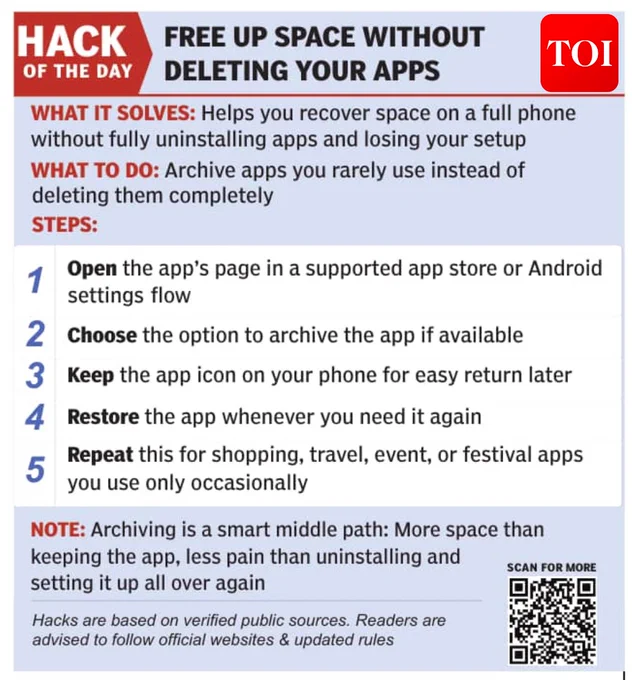
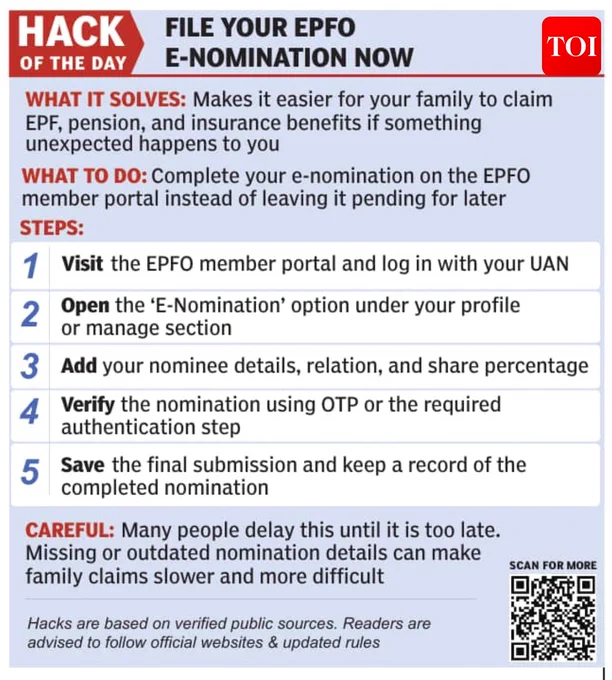
Fourth — and this is where it gets interesting — design. Anand built a visual template in SVG that matched TOI's existing "Hack of the Day" format exactly: the red header, the dark title bar, the numbered steps, the careful warning label at the bottom. The JSON was fed into a coding agent, which wrote the SVG code that filled the template.
Note what Anand did not do. He did not ask the AI to draw anything.
Anand, explaining to Sajeev Kumarapuram (Visual Journalist)
"ChatGPT is better than one of the best programmers in the world. On the software benchmarks, it is actually beating the best programmers. Now if you said, 'I want you to draw an image' — you are talking to a class-5 student. But if you say, 'I want you to write a program that can create an SVG' — now you are talking to a world-class expert. That's what I am doing."
This distinction — between asking AI to draw and asking AI to code something that draws — is one of the most important practical insights in the story. It explains why the results were not fuzzy AI-generated images with wrong fonts and mangled logos. They were clean, print-ready SVG files with pixel-perfect typography.
The Font Problem (and Every Other Problem)
Of course, nothing worked perfectly the first time.
Sajeev Kumarapuram, TOI's visual journalist and the person who would ultimately place these AI-generated files into print layouts, had a very specific concern.
Sajeev Kumarapuram, Visual Journalist, Times of India
"If I say can you use this particular font, it's not able to understand. Fonts are one of the biggest challenges."
The AI would approximate fonts. It would pick something close. It would, in Anand's words, "give you three out of four colors — not the fourth." This was not a failure of AI. It was a failure of expectations. The solution was to simplify the constraints: use black and white as the primary palette, reduce the number of typographic variables, and let the AI succeed at what it's actually good at — layout, hierarchy, information design — rather than fighting over proprietary typefaces.
There was also the matter of a mysterious blue band that kept appearing in early SVG outputs. Anand spent an embarrassing amount of debugging time on this issue before discovering the root cause: he had simply forgotten to push the correct branch to GitHub.
Anand
"I just forgot to push. That's all it was."
Some bugs are profound. Some are Git commits you forgot to make at 11pm.
The Feedback Loop
Here is the part that separates Anand's approach from most AI experiments in newsrooms: the feedback mechanism was voice notes on WhatsApp.
Richa, the reporter anchoring the feature, would send voice messages reviewing each AI-generated hack — exactly as she might leave feedback for a junior colleague or a cartoonist: "This one is too complicated." "This one we've done before." "Can you make the steps shorter?" Those voice messages were transcribed and fed back into the agent as updated instructions.
The Brilliant Simplicity
The editorial review system was WhatsApp voice notes → transcription → prompt refinement. No special interface. No training data. No fine-tuning. Just talking to the AI the way you'd talk to an intern. The AI, unlike most interns, remembered every correction and applied it to every subsequent card.
Anand built a small review website — deployed automatically to GitHub Pages — where Richa and the team could browse all generated hacks, mark them "Accepted / Rejected / Pending," and download the SVG or HTML files. TOI's designers could then open these in Illustrator or InDesign, make minor adjustments, and place them directly into the print layout.
What the Cards Looked Like
Here is an example of what the AI was generating — a card based on the real data from the content pipeline:
The critical reframe is this: 72% of the verification work was saved, at better-than-human accuracy. And this 0.7% residual error? Anand's hypothesis: "I think it's because I am wrong — not it." The ground truth used to benchmark the models had human errors in it.
Rohit Saran
"100%. 100%. Verifying 100% is easier than creating from 0 to 50."
The Deeper Disruption: What AI Is Actually Doing to Journalism
Somewhere in the middle of a call about induction cooktops — there was a genuine, multi-minute digression about gas versus induction cooking, triggered by a story about Iran-Qatar gas disruptions — Rohit said something that stopped the conversation.
"Some of the bloodbath in the media because SEO engines are collapsing is a huge business disruption, but it's great news for journalism. Because so much of shallowness was floating."
— Rohit Saran, Managing Editor, Times of India
For the past decade, the internet news economy had been built on a dark bargain: chase SEO metrics, produce templated content, optimize for clicks rather than understanding. Every major news organization knew this was corrosive. None could afford to stop.
Now, AI is making that model obsolete. Google's AI overviews are eating the traffic that came from shallow "what are the five things that rose the most" articles. The templated commodity story is being commoditized out of existence by the same AI that makes deeper journalism possible.
Anand calls this the bypass strategy: don't try to replace what already exists. Build something new alongside it, let it prove itself, and watch the old system gradually become irrelevant by comparison.
Saikat Dasgupta, on the pace of AI adoption
"The pace of realization [of AI's impact] is exactly the polar opposite of the pace at which it is doing it. It's stunning."
What Saikat means: AI is moving at warp speed. The people who need to understand and respond to it are processing it at human speed. The gap between the two is where disruption lives.
The Warning at the Peak
Not everything in these conversations was triumphant. Anand, who has thought more carefully about AI's failure modes than almost anyone in the country, offered a warning at the moment of maximum optimism.
Anand
"This may actually be the peak of optimism that we may have in the cycle, at least for the short run. Because right now we've seen what it can do. We haven't seen the failures yet."
Every technology follows this arc. The peak of inflated expectations, then the trough of disillusionment, then the plateau of productivity. AI in newsrooms is somewhere on the steep upward slope right now. The failures will come — the hallucinated facts, the misattributed quotes, the subtly wrong statistics that get into print before anyone catches them.
His advice: don't wait for perfection. Build systems that catch errors. Start with use cases where errors are low-cost and reversible. "Hack of the Day" tips about digital tools is an ideal starting point — the worst that happens if a step is slightly wrong is that a reader tries a menu that doesn't exist.
The Institutional Knowledge Insight
One of the most underappreciated aspects of Anand's work is what he calls "codifying institutional knowledge." Every judgment call he makes — how to structure a data story, what anomalies are newsworthy, how to fact-check statistical claims — gets encoded as a prompt. "This is how institutional knowledge starts getting codified." The prompt becomes the procedure. The procedure becomes the policy. The policy outlives any single person.
What the Prompts Actually Look Like
One of the most valuable things Anand does — and one of the least visible — is prompt engineering. His prompts for Hack of the Day are not a single line. They are documents. Instructions built up over weeks of iteration, encoding everything about editorial judgment that previously lived only in Richa's head.
Here is the kind of instruction that turns a language model into a Times of India tipster:
The Futures Being Planned
By the final conversation in this series — a call on March 25, 2026 — the tone had shifted from "let's try this" to "let's build more." Saikat summarized the state of play with characteristic directness:
Saikat Dasgupta
"Hack of the Day I see is largely cracked."
Which meant it was time to talk about what came next. The list of future projects being actively discussed by this small group — a Singapore-based AI practitioner and four journalists in Delhi — reads like a product roadmap for journalism in 2027.
The AI Headline Evaluator. Rohit's most urgent request. A tool that assesses any proposed headline against three criteria: factual accuracy, analytical rigor, and emotional resonance. It generates three or four alternatives for every headline. The new Copenhagen-built CMS coming into TOI from March 20 would be the integration point.
The AI Junior Editor. An agent trained on Rohit's editorial philosophy — encoded over years into prompts — that takes a first pass at every filed story. Not to replace human editing, but to catch the things that get missed when you're editing under deadline: the missing context, the statistic that needs sourcing, the logical gap between paragraph three and paragraph four.
Consumer Court Microsites. TOI has scraped all NCDRC consumer court judgments into a cloud database. An AI agent will surface the newsworthy anomalies: why does a consumer in Chennai get ₹50,000 compensation for a damaged iPhone when a consumer in Lucknow gets ₹2,000 for the same model? These are publishable stories. There are thousands of them.
The Cartoon Exhibition. Six AI agents, each with a different cartooning style, generate daily editorial cartoons based on the news. A private website shows all six side-by-side. Eventually — if the political and sensitivity checks can be worked out — this might be the strangest and most delightful experiment in the history of Indian journalism.
Data Anomaly Hunting. A standing agent that never sleeps, monitoring public datasets — NCRB crime statistics, RBI monetary data, IMD weather stations — for impossible values. The kind of thing a diligent journalist would catch if they had time to read every government data release in India. Which no human does. But an AI can.
"Treat their output exactly like how your journalists would. Let us see if any of these actually get published."
— Anand, on the idea of AI phantom reporters inside the TOI newsroom
The Chennai Design Festival Moment
On March 21, 2026 — a week after his last call with Sajeev about font rendering — Anand spoke at the Chennai Design Festival. He had prepared a talk. Then, 15 minutes before going on stage, he changed his mind.
He had been sitting in the audience listening to the other speakers — designers, architects, artists — talking about their creative process. He fed their ideas into Claude. He asked it to generate more. And then he walked on stage and presented Claude's output as his demonstration, in real time.
Anand, describing the moment
"I don't think there was a stronger way to make the point that: boss, all of what we know, hold dear, etc. is going outside the window."
He was wearing a kurta with a growth chart on it — a literal data visualization, printed on fabric. The audience, he reported, was "looking at the kurta in disbelief." Not at the chart. At the fact that this was a kurta at a design festival.
But the talk itself — the live demonstration of AI generating ideas from the very conference it was at, in real time — that was the point. Not that AI replaces designers. But that the boundary between human creativity and AI augmentation has become so thin that the only way to understand it is to stand right at the edge and keep going.
The Most Productive Meeting
At the end of their first session in Singapore, Rohit said something that landed like the final line of a good story:
Rohit Saran
"I'm so glad because this is just… I think probably the most productive meetings I've had. More productive than one day with OpenAI."
He had spent a full day with the people who build these tools. And found a longer-lasting return in a few hours with someone who simply uses them, deeply, obsessively, and with a journalist's instinct for what actually matters.
That, perhaps, is the real story here. The technology is extraordinary. The models are extraordinary. But the bottleneck — always — is the person who knows what question to ask. Who understands which problems are worth solving. Who can look at a feature called "Hack of the Day" running out of ideas and see, in that specific constraint, the perfect first step toward something much larger.
India's largest English newspaper now has an AI writing for it. It happened quietly, over six weeks, through video calls and WhatsApp voice notes. The first published hack suggested that readers show Gemini their screen for live help. The irony that an AI was teaching readers to use AI was not lost on anyone.
More are being published daily. Tagged #hackoftheday.