Before the workshop began, in the quiet of the principal's office, the school's correspondent, Sridharan, told Anand a story. It was about a lawyer named Sir P.S. Sivaswamy Iyeri — one of the most celebrated advocates in early-twentieth-century Chennai — who owned a grand one-and-a-half-acre property in the city. In the 1930s, the girls' school he had adopted ran into financial trouble. So Sir Sivaswamy did something almost impossible to believe.
"You can't believe what I'm going to tell you: he sold that property and came here and rented a premises somewhere in this street so that he could take care of the construction. That was his passion. When Raja Annamalai Chettiar had so many crores, he took a portion and built a university. But Sir Sivaswamy sold his home to build the school."
— Sridharan, School Correspondent
The school he built — part of the Sivaswamy Iyer institutions — traces its roots to 1869, one of the oldest schools for girls in India, from a time when, as Sridharan put it, "girls were not allowed to come out of the home." (Today it is co-educational.) A century and a half on, the inheritors of that mission were sitting in a classroom facing a very modern crisis. The teachers had, until recently, asked children to go home and write two pages of notes by hand. Not anymore.
"Now we don't say that at all, because everyone puts it into ChatGPT and brings it back. So we are frightened. We don't know how to deal with this animal called AI in the teaching-learning process. That is why you are here."
— Sridharan
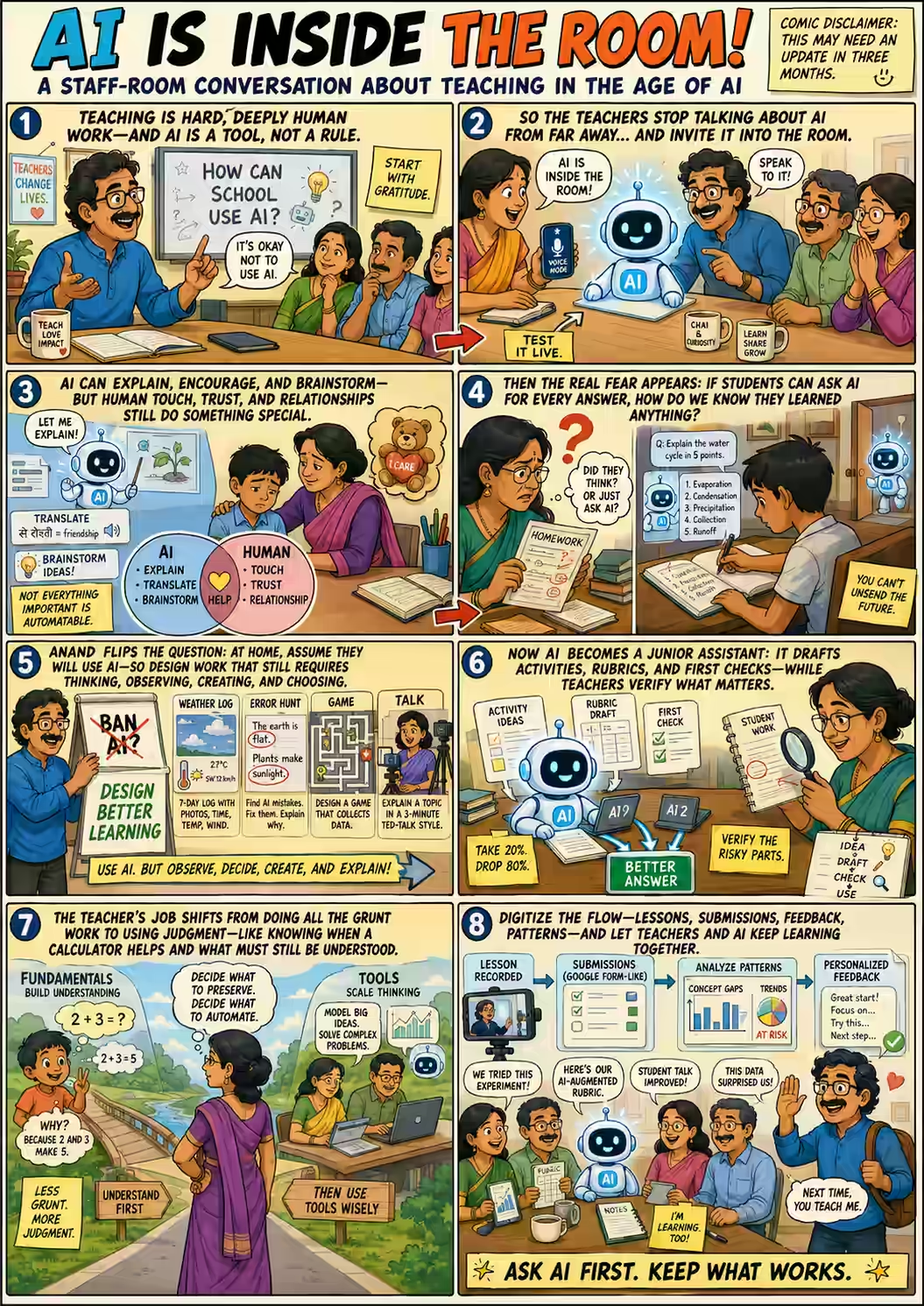
This is the setup Anand — an "LLM Psychologist" at Straive, and an instructor on IIT Madras's online BS in Data Science — walked into. And what followed over the next two hours was less a lecture than a live experiment. There were no slides. There was a great deal of Tamil. And at one crucial moment, the smartest participant in the room was a phone lying on a desk.
I · The PrincipleAsk It Everything
Anand began by dismantling the premise. Everyone, he noted, keeps saying AI, AI, AI. But his opening move was to grant the teachers permission to relax.
"Everyone is saying AI, AI. It is important — but at the same time, it's okay not to use AI. Sometimes we should use it, sometimes we need not. One of the things I'm very curious about is: everyone says AI will do everything — is there something it will not do? Because that is what I want to teach the children."
— Anand
It's a striking inversion. In a world sprinting to catalog everything AI can do, Anand's compass points the other way. The things AI cannot do — relationships, the felt weight of a parent-child bond, the reason his aunt scolded him for missing a funeral — are precisely the things worth teaching. And the surest way to find that frontier is to keep probing it. Which leads to his single organising rule, the phrase he returned to all afternoon:
"What strategy can we use to stay up to date? One thing I follow is: I try and ask it everything. Everything."
The logic is quietly profound. If you ask AI everything, one of two things happens. Either it fails — and now you've found something valuable to teach, or a boundary of your own skill. Or it succeeds — and you've learned a new way to delegate. Either outcome is a gift. "As long as I have things that AI cannot do, I'm happy," he said, "because I can learn where I'm useful. And I can also learn when the models improve."
For a man who has been programming for 30 yearsAnand has said elsewhere that in software — his home turf — AI is now better than he is. His comfort comes from being "reasonably good" in three or four other areas too., there's a bittersweet edge here. In software, his own expertise, he can no longer easily find problems that stump the model. But the reverse — hunting for tasks in domains he doesn't know — turned out to be the afternoon's most useful trick. His example was a contract.
The lawyer he never hired
The publisher BPB had asked Anand to write a book on LLMs and finance, and sent over a ten-page contract. "Contracts — even if you beat me, I won't be able to read them," he admitted (in Tamil: Contracts-ellam soodu pottaalum enakku padikka varaadhu). He has no legal training. So he handed it to ChatGPT — but not, crucially, to have it explained.
His first attempt failed: the AI dutifully explained the contract, clause by clause, and he understood none of it. So he corrected course, invoking something most people never touch — ChatGPT's memory, which lets the model recall everything it has learned about you across conversations.
"I said: 'No, no. We've been talking for years. You know me. Read the contract. I don't want you to explain it — even though that's what I asked. Do what I need: what should I tell BPB?'"
— Anand
The answer was startlingly specific. One clause forbade Anand from reusing any part of the book in his workshops. ChatGPT pointed out that the material had originated in his workshops — so it was "prior art" and should be excluded. "This is the first point you should make." When BPB responded with something equally impenetrable, Anand simply recorded the meeting, fed it back to ChatGPT ("Thalayum puriyala, kaalum puriyala" — I understood neither head nor tail), and read out the reply. They were convinced. "It seemed to understand their perspective; it seemed to understand mine."
This wasn't a party trick. It was a data point from a much larger study — one Anand cited to explain why he trusts AI in domains where he's helpless.
Anand referenced OpenAI's GDPvali — a benchmark where experts across dozens of the largest US occupations wrote real tasks, then blindly ranked answers from other experts against answers from AI. The result: a map of where, and how often, AI already beats the professional.
The numbers were uneven and revealing. In software, AI was better than the human expert 70% of the time last August; now, Anand estimates, closer to 95%. Contract review sat at only ~40%. Personal finance advice, ~70%. Auditing, a mere 20%. But here was the punchline that reframed everything:
"Contract review was only 40%. But that means it is better than 40% of the lawyers. I don't know any lawyer who can do a contract review for me."
That is the whole argument in one line. You don't compare AI to the best human in the world. You compare it to the human you can actually reach at 11pm on a Tuesday — which, for most of us in most domains, is nobody at all.
II · The Room Answers Back"The Head of Our AI Department"
Rather than hold forth, Anand turned the question around: How are you using AI? Where does it work? Where does it not? The room, it turned out, was already full of quiet power users.
One teacher confessed she asks it everything — including, memorably, whether she was a good pet parent. Her sick pet had left her doubting herself; ChatGPT reassured her she was "a brilliant parent." Anand, tallying the professions the machine had just impersonated, deadpanned: "So straight away we have three professions — a general physician, a veterinarian, and a counsellor." Then another teacher raised her hand with a question that would become the afternoon's first big laugh.
"How about astrology? … It matches horoscopes perfectly. It gives exact predictions. I can even put up a name board — 'Lakshmi Gayatri, Astrologer.' I can have a separate service."
— A teacher
It was Sridharan who supplied the punchline, in Tamil: "Ava dhaan head of our AI department" — She is the head of our AI department. The room dissolved. But underneath the comedy was a serious observation about the astonishing range of things teachers were already trusting to the machine — trip planning, health scares, calculations (where, one teacher noted wryly, "it goes wrong many times"), audio and video editing, translating picture-descriptions from English into Tamil. AI had, without any policy or training, quietly become a member of the staff.
Anand added his own favourite example. For a gathering of IAS officers at LBSNAA, he'd photographed the attendee list, asked Gemini to research each person, and generate a three-minute songGemini, Suno and similar models can generate full songs — vocals, melody and lyrics — from a text prompt. Anand fed it every officer's name and had it thank each one individually. thanking each of them by name for what they'd specifically done.
"It called out every person's name and thanked them for what they had done — just one sentence each. But when played in the group, that power was phenomenal."
"The morning sun rises over the secretariat corridors, illuminating the echoes of long nights spent in duty… To Ms. Mugdha Sinha, for the innovation that shapes the future of our service."
The touch that creates magic
Then the conversation deepened, and turned tender. A teacher who works as a counsellor described something AI could not touch — the moment a distressed child is calmed not by advice but by a hand on the shoulder.
"I can get theoretically a lot of explanations — do this, do this. But when a small child comes and I just put an arm around them and they calm down… this touch creates magic. That happens only between the client and the counsellor. It won't be seen outside. Do you think AI can develop to that?"
— A teacher & counsellor
Anand's answer was neither dismissive nor evangelical. Why, he asked, would a child ever leave a counsellor they trust for a machine? They wouldn't. AI is for the child who has no counsellor to reach — one more form of support for the unlucky ones. And then he reached for an analogy that hung in the air for the rest of the session:
"Hugging a doll and hugging your mother — for a child, they are one and the same. Like a teddy bear. But will we stop giving dolls? With dolls we have spent millennia; we know how to deal with toys. We don't yet know how to deal with this new toy. We have to learn that too."
— Anand
The counsellor pressed, genuinely unsure — could AI ever console a child in a real voice? "I don't know, that's why I'm asking," she admitted. Anand's reply was quiet and certain: "It will. Yes." There is a difference, he added, between touching and speaking, and between speaking and writing — and step by step, the machine is closing each gap. Tele-counselling, another teacher noted, is already the talk of the day. The distance between a counsellor on the phone and an AI in your ear may be smaller than we'd like to admit.
III · The TurnInviting AI to the Table
A teacher raised a genuinely hard question — the kind that could paralyse a whole staffroom. The CBSE syllabus now stretches to abstract territory: fourth and fifth dimensions, the sort of thing that made a teacher sit her students down beside her to puzzle through the tesseract scene in Interstellar. How, she asked, are we meant to guide children through concepts we ourselves can barely picture?
Anand's response was the pivot of the entire session. He didn't answer. He proposed a different move entirely.
"We are all talking here. AI is as smart as us. Why don't we invite AI to the table? Does anyone have ChatGPT on their phone? Open it, ask it this question now, and let's hear what it says. Let us invite it to the table. Why should it sit outside?"
(Tamil: AI en paavam veliya ukkaandhundu iruppane? — Why should the poor thing sit outside?)
— Anand
It's such a simple reframe, and yet it changes everything. The teachers had been treating AI as the subject of the meeting — a problem to be managed, an outsider to be discussed. Anand's suggestion was to treat it as a participant. Pull it into the circle. Let it speak. As one teacher marvelled a moment later, half in alarm: "AI ippo room-kulle vandhuvittadhu" — AI has now entered the room.
What followed was a small, beautiful piece of theatre. Anand asked a teacher to speak to it, not type. A senior person hesitated: "Enakku dhaan English-la thaduppu" (I get stuck in English). Anand's reply became one of the session's most quietly radical lines:
"Speak in Tamil, what's wrong with that?"
(Adha Tamil-la pesungo, idhula enna?)
And so the teachers asked their machine the impossible question — how do you prepare a child for a world fourteen years away, when you don't even know what next month looks like? The AI answered, patiently, with a list: learning how to learn, critical thinking, creativity, communication, emotional intelligence, ethics, resilience. Then, prompted further, whole careers that don't quite exist yet — AI ethicist, climate-adaptation engineer, XR experience designerXR = Extended Reality, the umbrella term for virtual, augmented and mixed reality experiences., learning-experience designer.
The teachers didn't swallow it whole — and that was the point. One shot back instantly: "Basic ethics — how will AI learn that to teach it?" Another insisted on filtering for "what facilities we actually have around us." Anand's synthesis was generous and clarifying:
"The responses divide into what we teach and how we teach. On 'what': it's ranging from 'let's teach what it says' to 'let's teach some of it' to 'let's teach what we know is important.' All of these are valid. The good part is: getting one extra opinion is helping our thought process. Even if we hear it and say 'no, that's not what we should teach' — good. You have a point of view that gets built."
— Anand
IV · The Calculator WarsHow Do You Grade a World With AI in It?
Now came the question every teacher in the room had been holding. It was posed bluntly: "How do I stop the student from getting answers from AI? That's not right, no?"
Anand's answer was to reach back half a century, to another machine that once terrified teachers: the calculator. His own maths teacher used to catch calculator-users with a trick question — what is 4 divided by 3? The honest students wrote 1.3 with a bar on top; the calculator crowd wrote 1.3333333. She could always tell. But, Anand asked, what was that really testing? And did she ban calculators forever? No — she taught them to use it later.
"It's like saying 'don't use a calculator.' In the exam hall you can enforce it. Sitting at home? If you say don't use a calculator, I can't enforce it — nor should I. What is the point of a take-home assignment done without AI? Then I'm teaching you not to use a good tool you have access to."
— Anand
He drew a careful map. There is a shrinking set of problems where you can still tell a human apart — a computer-science teacher described giving assignments where she knew ChatGPT's examples of a stack were limited, so when a student offered "removing a bangle from your wrist — first in, last out," she knew it was original, and could celebrate it. But that clever cat-and-mouse, Anand warned, is a "good fight against a calculator" — a set of problems that is small and shrinking. The question he actually cared about was harder:
"When AI is smarter than the child — smarter than the world's best experts in many areas — even then I still want to teach the child something. What do I teach?"
The assignment that grades itself
To find out, Anand did what he'd been preaching. He turned to his laptop, opened GPT-5.5 on "high thinking"Anand distinguished the fast "instant" mode (great for quick answers) from slower "thinking" modes that reason more deeply before replying — worth the wait for hard questions. and Claude side by side, and dictated — ramblingly, deliberately — a real request: design take-home weather assignments for CBSE students that survive the age of AI. His two asides here were pure teaching philosophy.
Ramble on purpose
"When I ramble, my thoughts become clearer. The smarter paid models make much better sense of what I'm thinking." Verbosity is a feature, not a bug.
Ask two, then merge
"I never ask only one model important questions." Paste each model's answer into the other: "take the better ideas, drop the worse. They have very little ego."
ChatGPT vs Claude
"ChatGPT does exactly what I tell it — perfect when I know what's right. Claude does the right thing even when it's not what I asked."
Pay for the smart one
The latest models reason "like professors"; the free ones, "like a college student." The ₹2,000/month plan? "The best 2,000 rupees anyone can ever spend."
He also let the teachers watch him fail. ChatGPT stalled on a weak network; he shrugged and took Claude's answer instead — modelling the exact resilience he wanted them to feel. And he slipped in his personal ritual for building a private map of the frontier:
"When it can't do something, I write it down: '9th of July, tried this, it couldn't.' Three months later I try again. If it works now — one more thing AI has improved on, and I've learned something new. If not, I've only wasted a few minutes."
— Anand
Claude's answeri was, by Anand's own admission, "slightly biased because I'm a data scientist — it knows me." Its top pick: a 7-day home weather log and prediction game. Each student records the weather at their own home twice a day, photographs the sky with a timestamp, predicts tomorrow's weather with one reason, then scores themselves the next day. The genius is in what can't be faked:
"AI cannot fake sky photos — but if a student is smart enough to get AI to fake sky photos, good! Give them a bonus mark for that."
The teachers, now warmed up, started firing their own subjects at their own phones — and the ideas cascaded back. A Class 10 AI teacher got an "AI board game for the confusion matrix using cards" and a "TED Talk challenge: why accuracy can be dangerous, precision saves lives." A science teacher got a supervised-learning exercise: label healthy vs unhealthy food, clean vs untidy classroom, "spot the wrong label." The realisation landed on the room all at once:
"Sometimes the answer to the question 'How do we design an AI-proof learning experience?' is to ask AI."
— Anand
Writing for an agent to read
Then Anand made the move that turned the whole anxiety on its head. One of his own IIT Madras course exercises: write an essay, use whatever AI you like — because I am going to hand it to Gemini with this exact rubric, and your job is to score the highest. At first he felt guilty for not grading it himself. Then it struck him.
"When they submit a CV for a job, it's an AI that will evaluate it. Before, we taught them to write so a human will read. Today they're writing for an agent to read. An agent has become a member of our society. This isn't an invalid exercise — it's the exercise they're not being taught."
— Anand
V · The Pain That Won't LeaveEvaluation, and a Question About Free Time
The correspondent, Sridharan, framed the school's real ambition. CBSE has moved to concept-based teachingi — under the NEP 2020 "5+3+3+4" structure, there are no longer just lessons and syllabi but concepts each child must master. And the enemy of that mission is time. A single teacher covers four or five sections of forty children — 160 notebooks per test, corrected on private evenings, unpaid. "Is there a way," Sridharan asked, "I can release that time to my teachers?"
Anand's answer was one of the boldest — and most humane — moments of the afternoon. It began with a flat contradiction of what everyone wanted to hear.
"Absolutely not. If you had more free time, would you say 'I won't do correction'? No. Usually you do only 95%, 98% of what you'd like. You've pushed yourself to the limit of what you're willing to do. So if technology cuts your work in half, you'll find more work and spend the same time. It is not the work — it is the amount of pain you can tolerate."
— Anand
It's a devastating little theorem about work. The constraint was never the correcting; it was human endurance. What AI changes, then, isn't the quantity of pain — it's the yield: for the same effort, how much good reaches the child. Sridharan sharpened his own point in reply: the goal isn't to reduce pain but to shift it — from mechanical correction toward creative teaching. And here Anand offered a genuinely surprising prediction about what working with AI actually feels like.
"Idea generation that took you 8 hours becomes 8 minutes. Verifying 4 hours becomes 2. You're 10× more productive on generation, 2× on verification — so the mix shifts. You'll spend more of your time verifying and thinking at a higher level. It's going to be even more exhausting."
"Please don't feel bad that you're spending less time but still getting just as tired. It's a normal reaction. We're just sitting in one place while it does the work — but it is very taxing on the brain. That, too, is a form of exercise."
— Anand
On the mechanics of grading, Anand was pragmatic. Three regimes: hand it to an LLM to assess against a stated rubric (and tell the students so); objective tests where AI writes a program to mark them — "in a program there is no hallucination; it works the same every time"; and subjective work, where AI assists but you keep watch. The trick he uses to run his Tools in Data Science course at scale is almost comically hands-off:
"That is how I run a course for 1,500 students. I have no visibility — I can see it, but I choose not to look at a single submission. Put it in your Google Sheet, send me the link. I download one Google Form, put it into ChatGPT, and say: 'Give me the scores. Do whatever you want. Just get me the answer.'"
— Anand
His rule for when to trust it is the sanest thing said all day. Treat AI like an assistant you are training — "like a maid, slowly it will understand you and you will understand it." Use it fearlessly where a mistake doesn't matter; monitor it where it does; but never refuse it work altogether.
"The question is when we delegate our decision-making to it. Do that judiciously — when you're confident. But build your confidence. Don't say 'I don't trust it, so I won't give it any work.' Don't trust it, still give it work."
— Anand
VI · Two StoriesThe Teacher Who Might Get Frozen in Time
Sridharan asked the question that haunts every experienced teacher. A ninth-grader in 2026 is "a completely different animal" from one in 2010. But the teacher spanning both years risks getting frozen — teaching the way she did fifteen years ago. How do we bring teachers up to the 2026 child, rather than dragging the child back to 2010?
Anand's reframe was expansive: swap "teacher" for "programmer" or "researcher" and it's the same question the entire economy is asking. And he offered not one answer but two — two equally noble stories a teacher might choose to live inside.
"One is the story of the progressive teacher, fighting hard on behalf of the student to prepare them for the future. The other is the story of the freedom fighter, holding the ground against the trend, preserving what is worth keeping for a future generation. Both are beautiful stories. Both are hard stories. The difficulty is guaranteed."
— Anand
A teacher made the case for the freedom fighter with a perfect image: "Using ChatGPT without knowing the subject is like using a calculator without knowing maths." Only a human, she said, can tell a child to "hold the 2 in your mind and 3 on your fingers." Anand honoured it fully — the struggle of early arithmetic wires the brain, teaches the abstraction that a number is a number whether apples or oranges. And then, without contradicting her, he made the case for the progressive teacher just as forcefully:
"In the job market, I have no reason to hire someone who spent their time learning mental multiplication over someone who can use Excel to build something three orders of magnitude more sophisticated. Both directions are valid. The salary they'll get, the market value — that will be higher. Both are valid."
— Anand
Bigger classes, better memory
One objection cut deep: when a teacher corrects 40 papers, she comes to know each child — where they stumble. Automate correction and that intimacy is lost. Anand agreed at 40 — and then flipped it at scale.
"With 40 people, I can know them. With 160, 1,000 — I can't individualise. But AI can. If I ask it, 'Give me the personality of each student,' it will tell me. Is it better than me teaching a class of 40? No. Better than me teaching 160, or 1,00,000? No chance."
— Anand
It's the machine-versus-muscle comparison, updated. A crane can't fold laundry as delicately as your hands — but it lifts 4,000 kilos. The right question is never "can AI do what the best teacher does?" It's: where there is no teacher at all, is an average AI teacher better than nothing?
"If there's a shortage of good teachers and AI is an average teacher, I'll use AI to teach all the children who don't have access to even an average teacher. That's good, right?"
VII · The One RequestDigitise Everything
As the closing bell approached, Anand distilled two hours into a single, concrete, do-it-tomorrow instruction — the one thing he'd ask of the school if he could ask only one.
"The biggest enabler — slightly outside AI — is: let the maximum amount of data be digitised. Whatever the student writes, any communication between you and the student — please digitise. Record your lectures. Just tie the phone around your neck and record it."
— Anand
Because once a lecture is a transcript, a whole evening's worth of impossible questions becomes a two-line prompt: What did I cover today? What did I miss from the syllabus? Two students were absent — email them a summary. Give me two spaced-repetition questions for tomorrow's refresher. Better still, ask students to type what they remember into a daily Google Form — "even if they ask ChatGPT, take that as input too" — and you can see, at the concept level, what the class absorbed and what slipped through.
"Whatever you teach — if it goes into AI, even just as a recording and transcript — it is like having ChatGPT attend your class. There is no higher-value activity than this."
(Idha vida higher value activity kidayadhu.)
And so the boldest single idea of the afternoon wasn't a model, or a prompt, or a policy. It was a phone on a lanyard, quietly listening — turning the ephemeral art of teaching into data a machine could finally help with. The session ended where it had turned: with AI no longer sitting outside the room, but pulled up to the table, taking notes.
Anand's closing wish, in Tamil: "Naanum kathupen" — I too will learn. He asked to return in a few months to see what the teachers had built — and, just as importantly, what they'd tried and failed at. "Failures are also important."