Section 01
"What do you think TDS is actually teaching you?"
Ten minutes in, Anand turned the microphone around. One sentence each. Raise your hand or type it in chat. What follows is one of the more remarkable pieces of collective self-assessment you'll read — a room of students describing, unprompted, a curriculum nobody wrote down.
"We want to cover all the scenarios that even AI would not think at the first go."
Rajkumar, on air"Sir, it takes the students into another dimension." (Anand: "One more sentence explaining that.") "The place that is not contemplated by the student."
Umapathi, on air"TDS is actually teaching us how to think, how to solve the problems and work with the data, not only just using the AI tools and all."
Angad, on air"Asking better questions."
Shishir, on air — the shortest answer of the hour"When somebody like you says it, it gives permission to get things done and move on rather than endlessly diving into theory."
Aditya, on air"AI is not rather than just your helper, but itself your co-pilot… or your partner which helps you to do your task faster."
Ishaan, on air"TDS has taught me how to fool large language models"
Varun, in chat"I have learned everything to learn nothing ….because execution may change in future"
Rohit Sharma, in chat"How to get the job done at any cost even if a student doesn't know basics"
Dev Verma, in chat"Its teaching me, Time matters the most."
Prince Khunt, in chat"problem solving skills and using your available resources in best possible way"
Gehlot Suyash, in chat"I agree that TDS helped us just to get things done but i also have a concern that I may not learnt anything new tbh as I feel everything is getting done by AI"
Himanshu Ranjan, in chat — the dissent
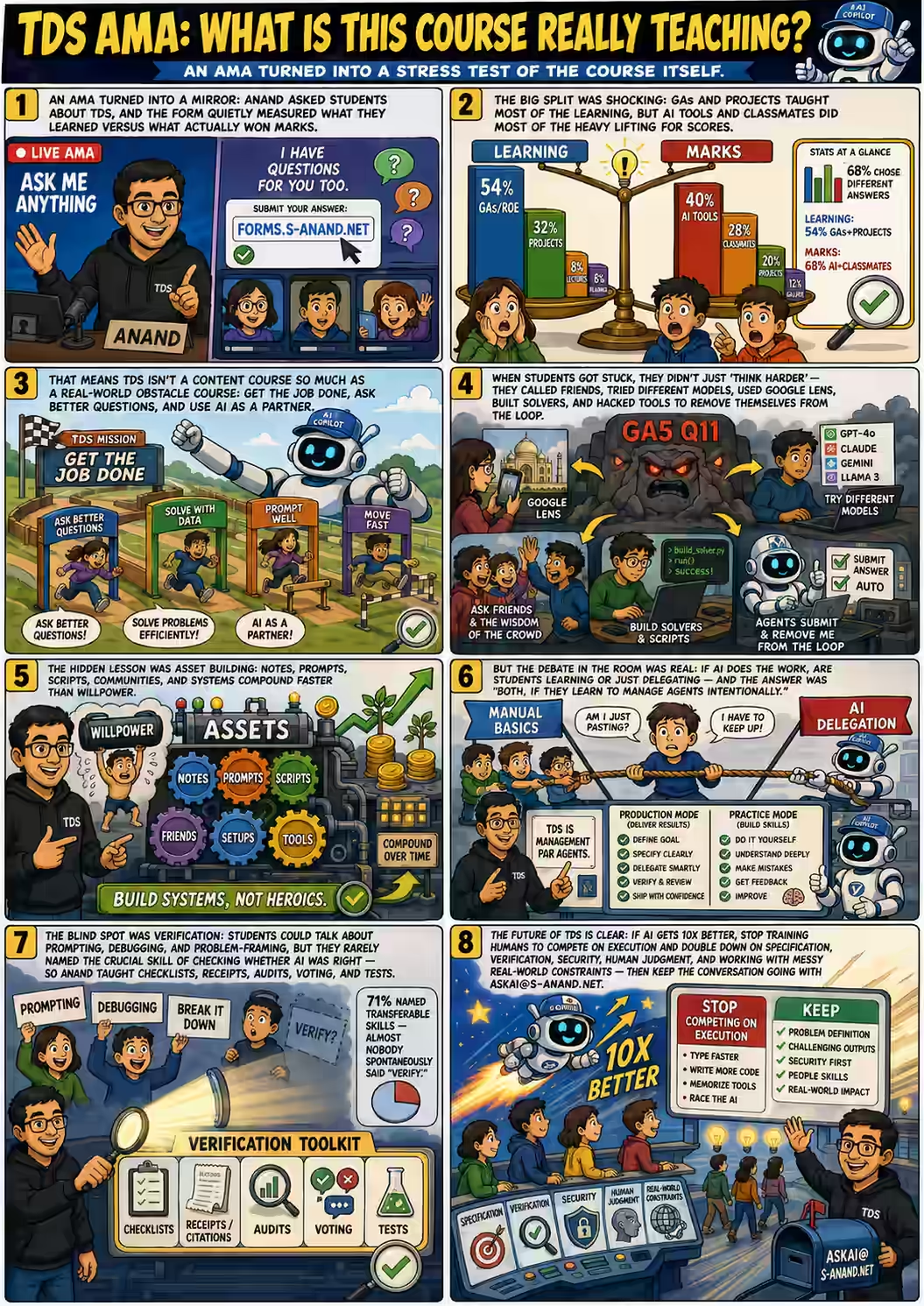
Notice what nobody said. Nobody named a tool. No Python, no FastAPI, no Docker, no uv. Twelve people described a stance — permission, partnership, question-asking, resourcefulness, time discipline. One person, Himanshu, said the quiet part out loud: maybe I learned nothing, because AI did it all. That objection will keep resurfacing, and Anand will spend a good part of the hour answering it.
Aditya's answer is the sleeper. "Permission" is a strange thing to list as a learning outcome — and yet, for students trained by a decade of schooling to keep reading until they understand everything, being told you may stop and ship is genuinely new information.
◆ ◆ ◆
Section 02
The exam that had to exist
The first question on the form was blunt: "As we are relying on AI for all assignments, what's the expectation from End term exam in person?"
Anand's answer was disarmingly honest. "The end term exam will be very simple." And then: "The end term in-person, no internet exam is a statutory requirement from the Senate, so it is there because it has to be there. I actually don't know what it will cover. Please ask Prasanna."
Prasanna, who sets the end-term, unmuted and took the question:
"It's more to give logical reasoning based on the knowledge that you have gained through these different courses… It will be a multiple-choice question, and there could be some subjective questions as well."
Prasanna, on the end-term
And here is the moment where an AMA turns into a design meeting. Anand, live, on the call, decided to change the exam:
"And now that gives me an idea. We will probably increase, Prasanna, if you're okay with it, the subjective-type questions a little bit… One of the major things is: how do we prompt and how do we verify? AI does the middle stuff well. The stuff that we ask for and checking the stuff that we get out is where the quality of prompts becomes important."
Anand, inventing a syllabus change in real time
The reasoning is neat. In an online graded assignment, "what prompt would you give for this?" is a trivial question — you paste the question into a model and ask it to write the prompt. That's meta-prompting, and Anand's verdict on it is generous: "Good technique." But in a closed-book hall with no internet, the same question suddenly measures something real. So: "practice learning how to prompt, specifying problems well, and verifying solutions well. These two will be part of the end term for sure, now that I think about it."
Now that I think about it. Somewhere, a hundred students updated their revision plans.
◆ ◆ ◆
Section 03
"Not only is it not a bubble, it is underestimated"
One student — Ishaan — was so keen on this question that he pasted it into the chat three separate times over half an hour: "do you think AI will bring a big crisis in the job market, or will it become a bubble like the 2001 dotnet bubble?" Uday had asked the same thing on the form. Anand took it head-on.
"Not only is it not a bubble, it is underestimated. Usually, people underestimate long-term impact and overestimate short-term impact. Short term, maybe we have overestimated — I don't know — even that I don't think so."
Anand, on the AI bubble question
That first sentence is Amara's Law being deliberately half-rejected. The argument that follows is the interesting bit: even if every model froze today, the unexploited potential of what already exists would keep the economy busy for years. Capability isn't the bottleneck; deployment is.
He then took the strongest counter-argument seriously — the claim that AI is growing along a single axis, and that intelligence is overrated:
"That may be true, but the sheer number of problems that we can solve given perfect intelligence is enormous."
Anand
Elsewhere in the hour, a subtler version of the same question arrived on the form and never got aired — Spandanjit asked whether TDS is chasing trends too hard, given that companies are already capping AI spend. It's one of the sharpest questions of the day, and it's sitting in the FAQ queue.
◆ ◆ ◆
Section 04
Willpower is a bad plan. Build assets instead
Jeevana had asked how to tackle complex tasks — what behaviours, how to work under pressure. The expected answer is grit. Anand's answer was almost the opposite of grit.
"People can push themselves behaviorally 5%, 10%, 20% better — maybe even 100% — by sheer individual ability, willpower, etc. But how much ability and how much willpower do you have, and how many courses will you apply that to? It helps to have something else that supports you."
Anand, on tackling hard things
Then a list of what "something else" means, which starts sensible and ends somewhere delightful. Agents are an asset — you give them a task, they get it done. Money is an asset — "I don't have to worry about cooking; I can eat at a restaurant, and that is one problem solved." Friends are an asset. Your notes. Your relationships. How you organise your laptop, your file system, your prompts, your scripts.
"Any kind of asset that you can build is an advantage… What are things that put you in a good position to tackle complex tasks without needing much by way of willpower or behavior change? That it happens automatically — that is the best situation."
Anand
And then the escalation ladder for getting out of bed at 6 AM, delivered completely deadpan: set an alarm. If that fails — "well, in my case, I tell my mother to wake me up." If that fails, commit to friends who will physically come and shake you. If that fails: "schedule a timer that will automatically, I don't know, turn on the AC, give you an electric shock at 6:00 AM — whatever."
The point underneath the comedy is a real one, and it's the same point as the course design: you are engineering systems and people to solve your problem so that you don't have to rely on your limited abilities. Which is, when you think about it, exactly what delegating to an agent is.
◆ ◆ ◆
Section 05
Field notes from GA5 Q11
Anand asked the room the single best diagnostic question you can ask a student: "Tell me about the last or most recent TDS problem where you were properly stuck. What did you do?"
Almost every answer converged on the same assignment. Graded Assignment 5, Question 11. It has entered TDS folklore. One student said it took two days. Another said four to five. It is the closest thing this course has to a shared trauma — and it turns out to be a near-perfect natural experiment in what "difficulty" even means.
"Last time in the GA5, if you remember, the question 11 is the toughest one. So I got stuck for the two days almost. And at last… we actually put some system which read the link from the TAs that how they are doing."
Angad, on air — remember this one"We all got stuck at the GA5 question 11. But our TDS community will work on it, and our wisdom of crowd will solve that problem."
Gaurav, on air"I didn't realize that the GitHub repository I created — and I had to create a YAML file which was supposed to be in workflows. I didn't notice it, so it took a long time. But the issue was so small it took a long time for me to realize that."
Umapathi, on air — on GA6, the classic sterile bug"A friend spent 700$ worth of tokens in claude code, and shared the solution with everyone."
Varun, in chat"my friends makes solvers and guides"
Himanshu, in chat"Used javascript scripts which copies all funtions and api requests and responses on answer checking, pasted that to ai for analysis"
Aman Kumar, in chat"also made solvers yesterday which solve the ga7 iin under minute…which is mindblowing"
Angad, in chat"Asked the question in the group which consists 600 students."
Prince Khunt, in chat"Take a step back, take a break. Then start again."
Divyanshu, in chat
Anand read the chat aloud as it scrolled: Varun's $700 friend, "which amortizes the cost, which is great." Devanarayanan's answer — "Build tools and use agents to get the human out of the loop" — got a single word: "interesting."
The image nobody could place
The other recurring nightmare was a Street View geolocation question in the ROE: here is a photograph, find its coordinates. Three completely different escape routes emerged, and each one is a different theory of problem-solving.
Route 1 · Switch the tool
Ask a different machine
"I was really stuck on that question for around two hours and I was trying to get help from all the AI agents and all, but finally I just asked the Google AI mode — the Google Lens's new AI mode — and it gave me the answer in two seconds."
— Ishaan. Anand, genuinely surprised: "I did not realize that Google AI mode probably has excellent street view recognition."
Route 2 · Do it by hand
Brute force and sunlight
"If you put it in Google Lens, it tells its Vienna. But now pointing the coordinates, it took me an hour searching through the city just to get to that place… it could have been done in three to four minutes, but again you have to brute force some things and just be good with street view, how to look at, you know, signs, directions, sun, and everything else."
— Divyanshu.
Route 3 · Leave the room
Take yourself out of the loop
"I basically used the agent. I told it to use APIs like OpenStreetMap or whatever. And I gave it — this is the interesting part — I gave it a way so it can submit answers. So I take myself out of the loop and I can solve other ROE questions instead of constantly copy-pasting."
— Devanarayanan. His chat message spells out the recipe: "give it bash tool with internet… Also give agent a curl command to submit my answer. Told it to 'loop till you get correct.'"
Three students, one question, three radically different definitions of "solved." That is the whole course in miniature.
The TA who was awake at 3 AM (and the students who noticed)
And then, mid-discussion, the chat produced the funniest and most revealing exchange of the hour. It began when Anand read out one of Angad's messages, deadpan: "Angad says, 'I know that Jaydeep TA sleeps at 3:00 AM.' Okay, that is helpful — leveraging the TAs is a good strategy."
Except Angad had not meant it as a metaphor.
Zoom chat · 24:25 → 32:58
Angad Jangir24:25"also i know that jaideeep ta sleeps on 3 am"
Jaideep (TA)27:06"Firstly, I don't sleep at 3am. But my sleep time on this is really weird?"
Mayank Poddar27:43"How do you find Jaideep's sleeping time?"
Varun28:00"One of our students found your endpoint being submitted around midnight, that's why they are bringing it up :)"
Varun29:20"They knew it was your endpoint because it was the first deployed endpoint that scored full marks on ga5 q11, way before everyone else"
Jaideep (TA)29:40"Oh my endpoint submission at 3am on that. I usually keep codex running over night it might be playing around with my system"
Varun30:45"You run codex without making it ask for any permissions @Jaideep?"
Angad Jangir31:34"yesh Right .You got the point , So i put a loop so that when your aerver be open and at that time I get the answer , so it kind of making more mind blowns and thinking more @jaideeep bhaiya"
Jaideep (TA)31:37"I am guilty for running on Yolo mode but yes"
Angad Jangir32:58"@Jaideep Yes i am thinking , may be in Future you will be more aware , also i think its really made me thinking that how to solve this .also sorry for that but i did."
Unpack that. A student noticed that one endpoint had scored full marks on the hardest question long before anyone else, reverse-engineered whose it was from the submission timestamps, and then wrote a loop that polled the TA's server and harvested answers whenever it happened to be up. The TA, cheerfully, explains that his 3 AM activity was Codex running unattended overnight in what he calls "Yolo mode."
Nobody was punished. Nobody was even scolded. In a course that grades resourcefulness, this is not misconduct — it is an unusually complete demonstration of the learning objective, performed by a student, on a teaching assistant, live in the chat, with an apology attached. Angad also mentioned, almost in passing, that TDS got him into bug bounties and that he'd found his way into a bank's admin page. Anand's reply: "That's something that we might be introducing in some of our projects going forward."
◆ ◆ ◆
Section 06
The confession: TDS was hackable for years
Angad had also submitted, on the form, a question that reads like a love letter with a challenge stapled to it: "I really appreciate the way you have designed TDS… is it wrong to feel that TDS can be made even more challenging?"
Anand's answer began somewhere unexpected.
"The difficulty is a relative thing these days. Somebody who finds that an agent has solved the problem — because maybe they've given the right prompt or have set it up the right way — finds that it's so easy. And somebody else who's figured out that they know the right people to reach out to finds that they have to take zero effort. And the people who have not yet figured it out are struggling."
Anand, on why "is it hard?" is the wrong question
And then, unprompted, the confession:
"For many years, TDS was entirely hackable, meaning all you have to do is figure out what is the API to send a request… the entire set of answer scripts is there, you just put in the score that you want, it will directly save that score. In that sense, every question was hackable. The percentage that hacked it was less than 2%, 3% for almost a year. So I left it open. Now we're finding that that percentage has gone up to about 15–20%, so now it makes sense to make it a little harder."
Anand, on the open endpoint he deliberately never closed
Read that again. The grading endpoint was wide open, and he knew, and he left it that way — because so few people had the resourcefulness to find it. The hack rate wasn't a security metric. It was a learning metric. When it crossed 15–20%, the lesson had been learned by enough of the cohort, and the difficulty had to move.
"If there is an open exposed endpoint, why are people not able to figure it out? There are many good reasons. They don't have enough friends; the community has not yet formed; they haven't thought about it. But these are also parts of things that we're teaching."
Anand
So: "Can TDS be made even more challenging? Yes, TDS is continuously becoming more and more challenging." Partly by design, partly because agents keep getting better and yesterday's hard question is today's one-shot. But with a governor on it — "there was a time when TDS was the easiest course… Right now, TDS is not considered among the easy courses, so we probably won't make it more challenging than the natural pace of students' learning."
The same question was transformative, enjoyable, and useless — depending on who you asked
Here is where the form did something the discussion couldn't. Half the respondents were shown "describe one painful TDS experience that taught you something you still use"; the other half got "…that taught you almost nothing." The split sample lets you see the same assignment from both sides.
Transformative
It changed my tools forever
"GA5 Q11 was huge pain to get through. That's when I decided to finally use Claude Code for help… The question didn't get solved by it as well, but I realized the tool was working better than the other models I worked woth before, leading me to still use it."
— Gehlot Suyash
Challenging
It changed my approach
"tds ga5 q11 challenge me to change my approach for solving a problems."
— Gaurav Tomar. And Angad, separately, found GA5 questions 9 and 11 so interesting that he asked for the course to be made harder.
Sterile
It taught me nothing at all
"i spent atleast 4-5 days with claude trying to figure out. Claude gave up saying it has done everything possible and I should try contacting the TA to get some tips. … Finally solved it with the solver that another student made. So indeed, all that time was lost without anything useful."
— Hema. A model telling a student to go ask a human for help is either the funniest or the saddest sentence in this dataset.
The conclusion writes itself: desirable difficulty is not a property of a question. It's a property of the meeting between a question and a particular learner at a particular moment. The useful design question isn't "is GA5 Q11 too hard?" It's: at what point does productive search turn into unproductive looping — and can a course detect that transition?
One student put the mechanism precisely, in answer to "what does the TDS team believe that you think is wrong?":
"There is sometimes an assumption that struggling with a problem for a long time automatically leads to learning. In reality, without timely guidance or feedback, students can spend a lot of time debugging the wrong approach and mainly learn how to get past that particular question rather than understand the underlying concept."
Angad Jangir, on the form
The counterpoint, from another respondent, is just as short and just as good: "Surprisingly, there was no pain that was not educational." — Aaditya Bugga.
◆ ◆ ◆
Section 07
Why learn anything, if the machine can do it?
Dev Verma had asked the objection that every teacher in 2026 is fielding: if students let AI do the basics, they forego the manual effort, and the only thing they learn is to operate a generic tool. Anand agreed with the premise and then declined the conclusion.
"When a tool is available to solve a problem, the industry is not going to pay someone to do the same thing slower, costlier, and at lower quality. Today, many of the things that an agent can do, there is no point for a human to learn to do."
Anand
Then the qualifier, and it's a good one. Sometimes the process is the point, not the product.
"Today we do exercise. Why? I mean, is there anything as pointless as exercise? Lifting a weight — a machine can lift a weight better than you can, but you're doing this to build your muscle. Similarly, why are we learning mental multiplication when a calculator can do it? Because it trains our mind to think about things in certain ways. The rigor is important."
Anand, on why we still learn things machines do better
So why does TDS refuse to teach the process? Because, he argues, everyone else already is. "Most of the courses are focusing on the process anyway. There aren't that many courses that are teaching you to get the job done. So I have the luxury of saying 80% anyway you're learning that. So in TDS, let me teach you that 20% which is not often taught."
And then the line that reframes the whole course:
"These agents are like people. They're smart enough. Now, management is a subject in itself where you get people to do stuff. In a sense, TDS is management for agents."
Anand
Which sets up his answer to Anusha's beautifully self-aware question — "For GAs I'm prompting LLM, getting answer and pasting. What do I learn from TDS?" The reply is a small masterpiece of pedagogical judo:
"You're learning how to prompt, and paste it, and getting the job done. Now, if it were that easy, you'd be scoring full marks in TDS. If you're not scoring full marks, then there is something that you haven't learned. And if a reasonably large number of people are scoring full marks, we'll then move on to the next stage of learning."
Anand
And the part he refuses to spell out, on purpose:
"This 'something to learn,' I'm hoping you'll figure out what it is by yourself — I'm not trying to make it explicit, partly because I don't know, partly because it is what I'm recruiting for, that is, your ability to figure it out yourself… In other words, good question — figure it out, like many other things in TDS."
Anand
It's worth noting he isn't speaking hypothetically about recruitment. Earlier in the hour, on whether the course makes you job-ready: "TDS is basically how I would recruit and what I'm giving people out as tasks within Straive or amongst our clients. So it is not even preparing you for job interviews; it is preparing you for the jobs themselves." With one caveat delivered immediately after — "in a year's time, this material will be outdated." The point is not the material. The point is learning how to be prepared when the material keeps expiring.
Section 08
How do you check an answer you're not qualified to check?
Jai Tyagi asked the question that sits underneath everything else: "How can we verify that an AI-generated answer is correct when we don't have enough expertise to check it ourselves?"
Anand's move here is characteristic. He refused to treat it as a new problem.
"This actually is an age-old problem. How does a judge who knows nothing about engines decide on a patent case between two parties about engines? How does a regulator who knows nothing about the telecom industry pass laws related to regulation? That actually seems to work reasonably well. How does an auditor who does not understand or have access to all of the information that a company does, come in and still verify?"
Anand
He then shared his screen and pulled up a talk he'd given three days earlier at the Data Hack Summit — titled, appropriately, "How do you manage something that is smarter than you?" — and walked through five verification techniques, each stolen from a profession that has practised it for centuries.
01 · Surgeons, pilots, diversChecklists
"Here are five things I expect in the answer. Is it working? Does it have it? Does it not?" You don't need to be the expert — you need the expert's list.
02 · Auditors, journalistsReceipts
"In our case, we ask for citations. Give me the original links, give me the actual files, show me the actual formulas. And this works very effectively too."
03 · Auditors, radiologistsAudits
"Give the same logic, the input and the output, to another model and have it go through and find all the errors and create an audit list. See where it fails."
04 · Juries, criticsVoting
"Ask ten people and see what the majority opinion is. In certain cases that works well, certain problems that's not the solution."
05 · Driving tests, compilersExams
"The agent writes a piece of code and then we give it to an interpreter, a compiler, whatever, and say, 'Run it.' If it passes the exam, great."
The fifth one is the one that's quietly eating the world. "This is exactly what's happening with mathematics today, which is the agent says, 'I have solved a theorem,' and we pass it to Lean, which is a programming language that can verify mathematics, and we get the result."
Can this generalise? Anand's example was insurance: take a policy, compile it into a formal language; take a claim, compile it into the same language; then mechanically check whether the clauses and exceptions fire. He called it "Insurly" — the demo is Insurle, and the underlying idea (formalise the contract, formalise the claim, let a theorem prover decide) shows up in recent neuro-symbolic agent research too. A sibling of the same idea is his own policy-as-code experiment.
"These are traditions from several professions in the past, and therefore how we verify need not be a new problem. It's something that we have solved in the past and we can learn from these professions as well."
Anand
◆ ◆ ◆
Section 09
The blind spot: the word nobody said
Now for the finding that only shows up if you go looking. After the session, all 70 free-text answers on the form — every durable-skill answer, every struggle story, every disagreement — were searched for four words.
Word counts across 70 free-text answers
0
"verify" /
"verification"
0
"validate" /
"validation"
This matters because it reveals the shape of the story students have internalised. It goes:
problem → AI/tools → persistence/debugging → answer
Which is a good story! It's the story of a resourceful person. But the story the course is trying to install is one step longer:
problem → hypothesis → answer → independent check → confidence
Debugging is "make the error go away." Verification is "prove this is right." They feel similar and they are not remotely the same skill — and the gap between them widens precisely as models get better, because a model that is usually right is far more dangerous than one that is usually wrong.
Which makes the timing of Anand's live decision to put prompting-and-verifying into the end-term look less like a whim and more like an instinct that the data confirmed an hour later. The suggested fix is almost embarrassingly cheap: after a question, ask one more question — "How do you know?"
Students, notably, are acquiring the behaviours faster than they're acquiring the vocabulary. 71% of the durable-skill answers described a portable strategy — decomposition, resourcefulness, collaboration, adaptation — rather than a named tool. They are doing something real. They just don't yet have Anand's word for the most important part of it.
Divyanshu's is the one to frame. He is not saying "I learned Claude." He has independently arrived at a portable theory of delegation and management — the same theory Anand has been trying to teach for years. That is what success looks like, and it showed up exactly once.
◆ ◆ ◆
Section 10
"What does Anand believe about learning that you think is wrong?"
The last question on the form was an invitation to dissent, and it was the one Anand most wanted answered. Twenty people took it. Eight said some version of "nothing" or "I don't know" — including the single best non-answer of the day:
"That sounds like another ROE question. I don't have an answer."
Umapathy G, declining to be assessed
The twelve substantive disagreements clustered into two camps, and they contradict each other — which is exactly what makes them useful.
Camp A · 6 responses
AI lets you skip the foundations
"If students do not practise basic way of writing codes manually, then they can not even understand tough things as they won't practise basics on their own and instead become more dependent on LLMs." — Dev Verma
"Using AI to solve all the questions, I believe it would take away people's ability." — Atharva Khandelwal
"Copy pasting from classmate without learning how to approach the problems." — Gaurav Tomar
Camp B · 4 responses
Struggle without feedback isn't learning
"The TDS team sometimes assumes that students learn best by figuring things out independently through challenging tasks, but some students may need more structured guidance, simpler examples, and clearer explanations before they can learn effectively." — Drishty Gupta
"TDS sometimes focuses too much on finding the correct solution and not enough on understanding the learning process." — Drishty Gupta
The outliers · 2 responses
Two very specific complaints
"When offline evaluation is done, especially for essays and other hand written answers, evaluating with an llm makes no sense. Training a student to write essays that a random large language model thinks highly of is not a useful skill at all." — Varun
And, with beautiful economy on what the team wrongly assumes: "That they will read every instruction." — Thanish P V
Now put Camp A next to something a student said in the open question. Varun — the same person who'd typed "TDS has taught me how to fool large language models" — asked:
"How do I overcome the TDS mindset creeping into other courses? I remember the first few weeks of doing java assignments after TDS started, I had to constantly resist the urge to paste the assignment into an agent and make the agent solve the assignment for me."
Varun, on the form — asked three separate times, which tells you how much it bothered him
This is the most quietly alarming data point of the day, and also the most encouraging one. Transfer happened. A habit formed in TDS reliably fired in an unrelated Java course. That is precisely what a course designer dreams of.
But look at what transferred. Not "decide what to learn versus what to delegate, then verify." Just: "delegate." The memorable rule turned out to be a little too memorable — and the tension students keep circling isn't should we use AI, it's when am I producing, and when am I practising? Production mode says: get a robust result efficiently, use everything. Practice mode says: install this capability in my head, so do one manual rep. TDS is almost entirely production mode — deliberately, distinctively — and students are left inferring the boundary for themselves.
Anand's answer to Varun refused to draw the boundary for him, and instead reframed the whole thing as a question of agency:
"This is like asking: how do I resist the urge to get onto social media? Or how do I resist the urge to just play video games… If you just went to the agents fully and said, 'You solve it for me,' there are certain skills that you will not be picking up. But maybe it doesn't matter. Maybe that is not the area that you end up learning skills in. Maybe you will spend the time that you save by doing that, learning something else. What could that be? I don't know. Professional dancing? Who knows?"
Anand, declining to moralise
The only instruction he was willing to give was about how to choose, not what to choose:
"Whatever you're doing, try to do it intentionally. If the mindset comes in, just pause for a second saying, 'I'm doing this. Do I want to do this?' And at that moment, if you say yes, do it. If you say no, don't do it. Secondly, write it down… You'll find journaling to be one of the most powerful techniques. And you can always take that journal, give it to an LLM also, and say, 'Here is how I'm deciding, how can I improve myself?'"
Anand
Or, compressed: "When you do something intentionally, at least you know where you're going and why." Prince Kurien, on the form, had independently proposed the institutional version of the same idea — "A learning log should be requested, along with a proportion of the mark for uniqueness."
◆ ◆ ◆
Section 11
"If AI becomes 10× better next term, what should I stop teaching?"
Anand's second big question to the room. The answers came fast, and collectively they sketch a curriculum that doesn't exist yet.
"We should stop teaching students to compete with the AI on execution. Instead, I think they should train the students to define the right problems and working with the messy, real-world constraints and also challenge the AI output."
Angad, on air"Creating FastAPI and GitHub URL repository and deploying it — that portion might become irrelevant. What would be more relevant is security. The security concept will be more relevant as it becomes 10x; the likelihood of exposure will be more."
Umapathi, on air"AI becomes ten times smarter, which means it has so much intelligence that it can solve any task. So we can learn how to interact more comprehensively with humans, with masses. That should be done because AI will solve everything."
Rohit, on air"You should ask students how they would approach the problem and ask them to document the problem and the solution."
Jai, on air"Instead of focusing on some common questions that can be easily solved by AI, we can go for some vague or innovative questions. It might not even have a better answer, but we can score them based on how well they come up with the answer."
Rajkumar, on air"In Project 1, there were questions like: the prompt which will prove the GPT wrong. So if it's 10x smarter, human should be able to build that intelligence — so prompting questions should remain."
Dev, on air"Stop teaching/giving individual microtasks — give substantial capstone projects"
Aaditya, in chat — the only message others explicitly seconded"Then TDS should add more privacy-preserving questions. I believe privacy will become huge concern, when AI will grow 10x."
Prince Khunt, in chat"Manual marking should remain"
Aayush Chourasia, in chat"ask them to create a social media account and how would they use AI to scale the account"
Jai Tyagi, in chat"Ask ai to come up with cheapest solution to real business problems"
Rajkumar, in chat"We should be able to strengthen our basics. Even though if AI is a great kind of thing, 10 times or 100 times, we will not be leaving our ABCDs."
Uday, on air
Anand's running commentary as he called on people was itself a taxonomy: "Interacting with humans rather than with AI. Got you." … "Security at scale is a fair point." … "Specification and verification is where I think you're going." … "Effectively evaluating outcomes rather than…" … "Working alongside rather than against AI."
Not one student proposed teaching more tools. Every single answer moved up the stack — to specification, judgment, security, documentation, human interaction, or the design of the problem itself. A room of students, asked to redesign their own course under a 10× capability shock, independently converged on the thing that AI cannot yet do: decide what is worth doing, and whether it was done right.
◆ ◆ ◆
Section 12
Careers: the rise of the vibe-code fixer
Aaditya — a self-described "non-tech person from a traditional industry" wanting to move into product management — asked for career musings. The answer was more optimistic than he probably expected.
"The execution part is becoming easy. So, telling agents what to do and figuring out if that is correct is growing. Therefore, the role of someone who is non-tech in the traditional sense, maybe even tech-adjacent, is growing. And this is exactly what a product manager does, which is telling a team what to do — and in this case, the agent becomes the team — and verifying if they've done their job right."
Anand, on non-technical careers
The economic logic: because agents execute so cheaply, the number of people needed to specify what to execute goes up, not down. The shape of those jobs? "I don't know."
Soham then asked the question every final-year student is actually asking: "TDS is hard but I loved it; still, traditional coding gets tough, so why is fresher job hunting still so heavily DSA-oriented?" (It took the chat a moment — Anand initially guessed DSA meant "Data Science and Analytics" before Devanarayanan, Aaditya and Suyash all corrected him in unison: Data Structures and Algorithms. Varun's gloss: "leetcode grinding etc".)
The answer had two halves, and the second half surprised the room.
Half one: the industry hasn't caught on yet, and there's a chain of reasons why. "There is an HR team who gets requirements from the business team, who gets requirements from the client project manager, who gets requirements from the client business stakeholder. If the client business person has not yet caught on to the need for someone with a very different skill profile, the entire chain has not yet caught on." His estimate: Data Science took three or four years to establish as a role. "I expect forward-deployed engineers to happen a little faster than that, probably a lot faster."
Half two: actually, DSA is about to matter more, not less.
"There really is a need for Data Structures and Algorithms because people are vibe-coding like crazy. A big role that is emerging is 'vibe-code fixer.' Somebody has created it, it's a mess — which is a good thing because somebody's finding it to be a useful mess. So somebody has to come and clean up the mess."
Anand
Or, in the least sanitised phrasing of the session: "maintaining code, which people and agents have vomited out and nobody knows what to deal with, will be a growing thing." Two demand curves rising at once — "the demand for agentic use will grow a lot. But the demand for more structured programming will also grow."
How to predict five years out (spoiler: you can't, so predict something else)
Shivam asked how to read the direction of AI over five to ten years. Anand's answer opened with a confession — "I am trying to figure out as well and I'm in the same boat as you are" — and then offered a genuinely useful trick: stop predicting where AI will go, and predict where it can't.
Anchor 1Physics doesn't move
"If there is something that is constrained by physics, then I know that no matter how fast things change, technology changes, that will be a reasonably safe space to work in."
Anchor 2Regulation doesn't move fast
"No matter what, drugs will have to go through a rigorous testing… So I know that any kind of drug approval related areas will not change so fast thanks to AI."
Anchor 3Human behaviour doesn't move at all
"Just because AI is going to make things fast, we're not going to start working two hours a day… So if AI can do more, we will do more. We won't do less."
The short horizonRead the insiders
"What are people inside Anthropic saying? What are people inside OpenAI saying? They are able to see things three, six months at least ahead of we are. And if multiple people are saying the same things, I know that that is likely to happen."
That third card is the sharpest observation in the section, and it doubles as a labour-market forecast: if AI raises output per hour, we don't get shorter days. We get more output. "These are businesses that one can invest in because you have something that is likely to be protected irrespective of technology."
◆ ◆ ◆
Section 13
Two questions about course design, answered like an engineer
Shishir had a complaint that reads like a bug report: "Why are we saving the last submission instead of the best submission? Since we create the server only once, and it is hosted on Cloudflare, it may be lost or reset, causing all progress to be lost."
Anand did two things at once. First, he took the suggestion seriously and immediately imagined how he'd exploit it: "Supposing I said we'll take the best response. Here is how I would approach the question. I would create 30 servers, tell it, 'Create random answers.' One of them is bound to be right." Not a criticism — an endorsement. "This is not a bad strategy. And I'm not trying to discourage that strategy either." He took it as a to-do: some future questions will explicitly say toss 100 answers at it, we'll take the best.
Then he explained why it can't be the default, and this is the best defence of an annoying design decision you'll read this year:
"The whole point of I'm hosting it in an environment where it might get reset — that is exactly the kind of real-life problem that an agent is not going to be able to solve for you. Today agents can create so much code that creating the code is not the difficult part. It is: how do I get the code to be reliable enough in a deployment environment? … If I can't run 10 services in one session, keep them all alive, then I haven't picked up the skill to be able to deal with the deluge of code and services that agents will be able to provide."
Anand, on why your Cloudflare deployment has to still be alive at grading time
Or, in one sentence: "the thing that is difficult is exactly what we're trying to test if you're able to learn."
Can AI judge human experts?
The last question of the hour, from Jai: can AI agents act as judges or auditors of human expert work in high-stakes domains? Anand inverted the framing entirely.
"If an AI agent comes in and says, 'I think you are doing X right and Y wrong because of blah blah blah,' it is so high-stakes that I will verify what it's saying as well. Now it's giving me an extra pair of eyes. I wouldn't mind. So if we use AI as an additional pair of eyes, it's both harmless and reasonably high impact because it might be able to literally look at things with a fresh perspective."
Anand
The counterfactual matters: high-stakes industries need experts, and experts are expensive. If AI can prepare 50% of what an expert checks, so the expert only has to glance and approve, that's real leverage — with the caveat that you'd still sample outputs to watch for drift.
And then the reframe that should probably be printed on a poster somewhere:
"I don't think the segmentation is: is this high-risk or low-risk industry? It is: how we break the task. Is it generation or is it verification? Is it preparation of verification or is it approval of verification? Is it verification of simple tasks? Is it verification of subtle tasks?"
Anand, on the only risk taxonomy that actually works
Which lands us, an hour later, back at the word nobody in the room had used about themselves.
◆ ◆ ◆
Section 14
The close: an email address that answers itself
The hour ran out with fifty-odd questions still unanswered on the form. So Anand did the most Anand thing possible. He gave the students an agent.
"For the next 21 days, till the end of the month, my email ID is available and I'll give you a specific email ID: askai@s-anand.net… Any email that any of you send to this will be answered by my agent, which has all the context of TDS and my work and everything else, and you will get a response within a day. It's a human-in-the-loop; I'm still very much looking at the inputs and outputs, but it saves me bandwidth."
Anand, closing the session
Consider what just happened. A course that spent an hour arguing about when it's legitimate to delegate work to an agent ended with the instructor delegating his own office hours to an agent — and disclosing it, precisely, including where the human stays in the loop. Checklists, receipts, audits, voting, exams; specify, then verify. He demonstrated the entire curriculum in ninety seconds, using himself as the worked example.
Angad, who had spent the hour looping a TA's server, had already typed his verdict into the chat a few minutes earlier:
"Sir, the way you think about problems and design questions inspires me a lot. I feel if a professor can think at this level, then I should also push myself to reach that level someday. That's why, Sir, you are genuinely one of my idols."
Angad Jangir, in chat