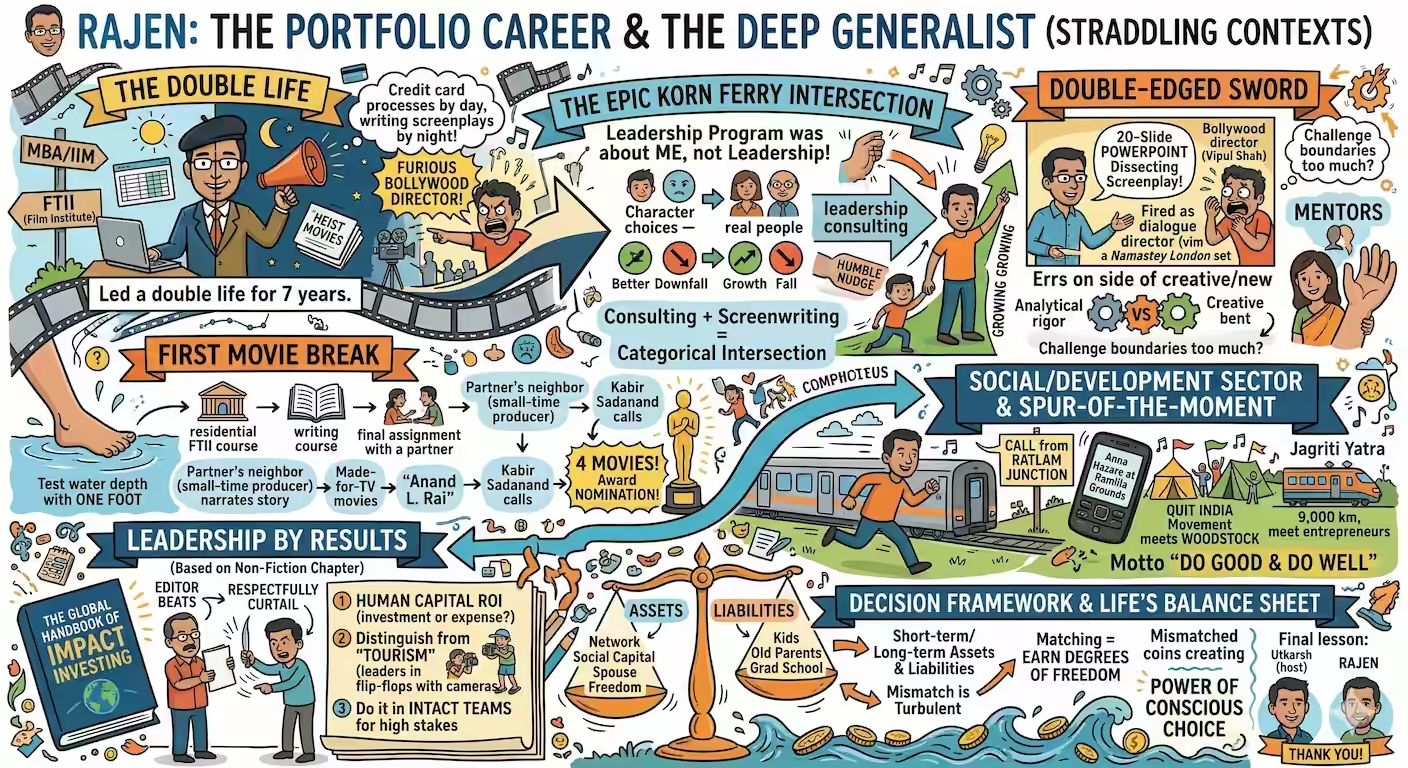
If you want to understand the career of Rajen Makhijani, you have to start with a PowerPoint deck. But not just any deck. This was a 20-slide presentation designed to dissect a screenplay for a major Bollywood director. It was rigorous, analytical, and entirely out of place.
Makhijani had been invited by Vipul Shah to write dialogues for Namastey London. But the consultant in him—the man who had spent years at firms like McKinsey—couldn't help himself. He applied his analytical toolkit to the creative structure. The result? He was promptly fired.
"It didn't go down too well!" he laughs now. "I bring almost an analytical rigor to the creative world which I think makes things sometimes better, sometimes not quite. And likewise the creative bent to my management consulting work."
This is the story of Rajen Makhijani, a man who leads what he calls a "double life." By day, he is a Client Partner at Korn Ferry, advising global boards on leadership and ESG. By night, he writes heist movies and award-nominated telefilms. He is what Utkarsh Amitabh, founder of Network Capital, calls a "Deep Generalist"—someone who builds a "Category of One" by standing at the intersection of seemingly unrelated worlds.
The Choice Experiment
What connects credit card processing to screenwriting? On the surface, nothing. But for Makhijani, the link is the human choice.
Early in his career, while participating in a McKinsey leadership program, he had a realization that changed his trajectory. He went in expecting to learn about leadership as a skill, but he left realizing the program was actually about him.
He saw that a leadership coach is just a screenwriter for real life. He could be "that one little humble nudge" that helps a leader make a choice that leads to growth rather than a fall. By merging his creative obsession with human psychology and his corporate platform, he found a way to "get rid of the excuses" of his life.
The One-Foot Rule
Most people view a career shift as a leap of faith. Makhijani views it as an experiment. He cites an old African proverb: "If you want to test the depth of the waters, use one foot."
When he wanted to explore filmmaking, he didn't quit his consulting job. He took a one-month residential course at FTII while still employed. He joined a screenwriting course called Kalam. He wrote a script with a partner whose neighbor happened to be a TV producer. One thing led to another, and soon he was working with Aanand L. Rai.
This "dipping of the toe" allowed him to build a portfolio of four produced movies and an award nomination without ever losing the analytical anchor of his corporate career. He proved that you don't have to choose between being a "suit" or a "creative." You can be both, provided you are prudent with your experiments.
Leadership vs. Tourism
In his professional work, Makhijani is a devotee of Robert McKee's Story and Aristotle's Poetics. He applies the principles of escalating stakes and expectation-reality gaps to organizational advisory. This led him to co-author a chapter in The Global Handbook of Impact Investing.
His central thesis: Leadership by Results. He makes a sharp distinction between real development and what he calls "Leadership Tourism."
By forcing leadership programs to be accountable to ROI—even proposing EBITDA multiples for human capital—he forces the corporate world to treat people with the same analytical respect they afford to financial investments.
The Life Balance Sheet
How does he manage the "indulgence" of these detours? Makhijani has taken several, including a seven-year stint in the social sector working on Swachh Bharat and serving the UN. He credits his wife as the "fulcrum" that allows for this experimentation, but he also uses a specific decision-making framework: The Life Balance Sheet.
"Assets and liabilities are not just financial," he explains. A liability might be a child's education or aging parents. An asset might be your social capital or a supportive spouse. The key is to match them—short-term assets to short-term liabilities, long-term to long-term. This matching earns you your "Degrees of Freedom."
"After you've earned your degree of freedom already, do not waste it! Use it! And if you haven't, then be prudent."
This prudence is what allowed him, upon reading about the Anna Hazare movement on a BlackBerry in Singapore, to jump on a plane to Delhi the next morning. Or to answer a call from a political leader and end up at Ratlam Junction on a whim. These weren't just impulsive acts; they were calculated withdrawals from his "Degrees of Freedom" account.
The Accomplished Beginner
The greatest challenge of a portfolio career isn't time management; it's ego. When you move between worlds, you are constantly reset to zero.
Makhijani's career is a masterclass in this balance. He maintains a "genuine healthy respect" for specialists who have stuck to one field, while leveraging his outsider's "Category of One" perspective to solve problems they can't see.
Ultimately, he believes in the Power of Conscious Choice. In any given moment, there are infinite directions a life can go. The goal of a "Deep Generalist" is to become self-aware enough to exercise that choice, to frame the situation correctly, and to find the intersection where magic happens.